The Official State Gazette (BOE) sets the minimum tread depth for trucks and heavy vehicles
Tire maintenance has always been a key aspect of vehicle safety, but it's even more crucial for trucks and heavy vehicles. Now, the Official State Gazette (BOE) has updated the regulations, clearly establishing the minimum tread depth required for tires on trucks, buses, trailers, and heavy semi-trailers.
This change comes with Order PJC/528/2026, of May 26, published in the Official State Gazette on May 29, 2026. This order modifies several annexes of the General Vehicle Regulations, including Annex VII, which deals with tires.
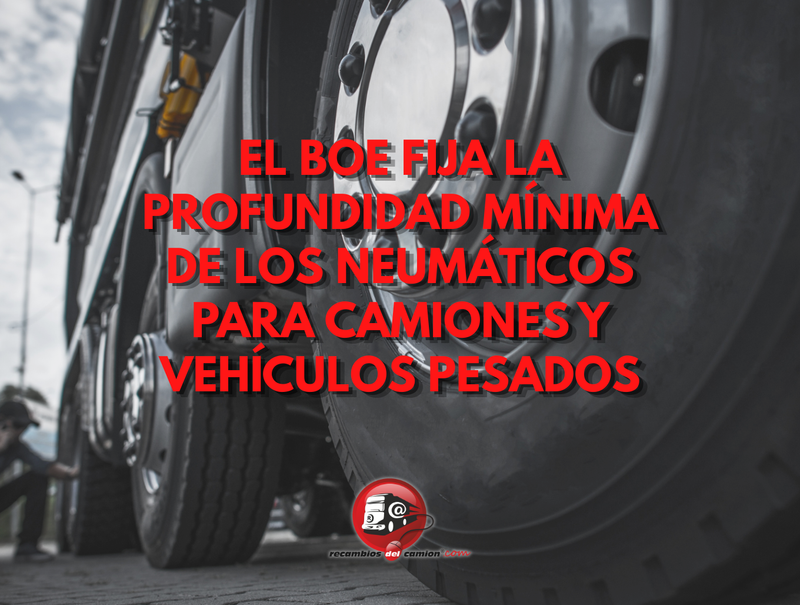
According to the new text in the Official State Gazette (BOE), heavy goods vehicle tires must maintain a minimum tread depth of 1.0 mm in the main grooves throughout their use on public roads.
This measure affects vehicles in the following categories:
- M2 and M3: buses and coaches.
- N2 and N3: vehicles intended for the transport of goods exceeding 3,500 kg.
- O3 and O4: heavy trailers and semi-trailers.
Therefore, in the case of trucks, the minimum legal requirement is set at 1.0 mm.
The same amendment maintains the usual limit of 1.6 mm for vehicles in categories M1, N1, O1, and O2.
In other words, for passenger cars, light vans, and light trailers, the minimum mandatory tread depth remains at 1.6 mm in the main grooves of the tire.
The Official State Gazette (BOE) clarifies that the main grooves are the longitudinal and transverse grooves that form part of the main tread pattern.
In practice, these are the areas of the tire that allow water to be evacuated, maintain grip, and ensure safe vehicle handling, especially in rainy conditions, under braking, or with a heavy load.
The update also clarifies the section on special tires. The Official State Gazette (BOE) considers special tires to be snow tires identified with the markings M+S, M&S, or M.S along with the 3PMSF pictogram, the symbol of the three-peaked mountain with a snowflake.
This also includes tires designed and approved for professional off-road use, identified with the markings M+S, M&S, or M.S along with POR.
In the case of winter mobility restrictions, vehicles over 3,500 kg must be equipped with 3PMSF or POR certified tires, at a minimum, on the steering axle and drive axles.
Outside of these areas or periods of winter restrictions, vehicles may use different types of tires between axles, always complying with applicable regulations.
Until now, the most widely known reference was the minimum tread depth of 1.6 mm for passenger cars and light vehicles. With this update, the Official State Gazette (BOE) specifically incorporates the criterion for heavy vehicles, setting the minimum at 1.0 mm.
For haulers, workshops, fleets, and transport companies, this clarification is important because it allows them to know more precisely when a tire no longer meets the regulations.
Furthermore, beyond the legal minimum, driving with worn tires increases the risk of loss of grip, blowouts, longer braking distances, and problems during inspections or roadside checks.
Although regulations stipulate a minimum tread depth of 1.0 mm for trucks and heavy vehicles, it is advisable not to wait until reaching the limit. A severely worn tire can compromise vehicle safety, especially when driving with a load, in the rain, or on long journeys.
It is advisable to periodically check:
- Tread depth.
- Uneven wear.
- Tire pressure.
- The presence of cuts, deformations, or cracks.
- The overall condition of the tread and sidewalls.
Preventive maintenance helps avoid breakdowns, fines, and dangerous situations on the road.
The new update to the Official State Gazette (BOE) sets the minimum tread depth for truck, bus, trailer, and heavy semi-trailer tires at 1.0 mm.
For passenger cars and light vehicles, the minimum remains at 1.6 mm.
This modification provides a clear reference point for professional transport and reinforces the importance of regular tire checks. For heavy vehicles, tire condition not only affects fuel consumption and wear but is also a direct matter of road safety.
Other related articles
 Aug. 24, 2026
AI-powered cameras in Catalonia: Distraction controls on the A-2 and AP-7
For a professional driver, maintaining their license points and avoiding penalties is … Aug. 5, 2026
Solar eclipse 2026: traffic restrictions update
Traffic restrictions planned for the total solar eclipse on August 12, 2026, … July 22, 2026
2026 Solar Eclipse: Traffic Restrictions and Special Measures
The total solar eclipse of August 12, 2026, will be one of … July 10, 2026
Will breathalyzers be mandatory in 2026? Which vehicles are required to have them?
In recent days, numerous news reports have claimed that, from July 7, … June 15, 2026
Opinions of our clients
Receive our news