2026 Solar Eclipse: Traffic Restrictions and Special Measures
The total solar eclipse of August 12, 2026, will be one of the most significant astronomical events of recent years, but it will also pose a major challenge to road traffic. Thousands of people will travel to areas with good visibility to observe it, coinciding with one of the busiest traffic periods of the summer.
In response, authorities have begun preparing special measures to reduce traffic congestion, manage access to viewing points, and maintain road safety. The most significant measure for commercial transport will be implemented in the Basque Country, where heavy goods vehicles weighing over 7,500 kilograms will be prohibited from circulating on August 12.
In the rest of Spain, the Directorate General of Traffic has also developed a special plan that will allow for the implementation of various measures on the roads of the most affected regions.
However, it is important to clearly differentiate between the two situations: currently, the general ban for trucks is confirmed in the Basque Country, while the actions planned by the DGT (Spanish Directorate General of Traffic) may vary depending on traffic, the road, and the locations chosen to observe the eclipse.
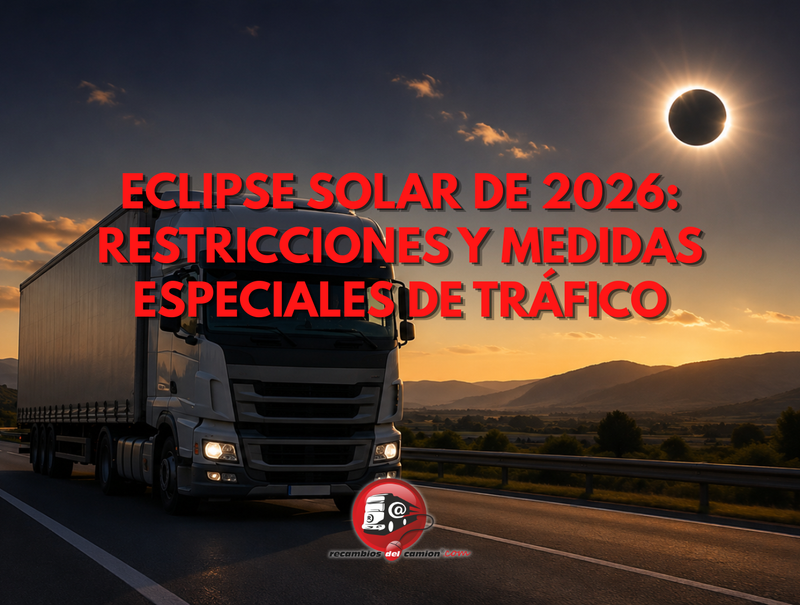
The Basque Government's Traffic Department has approved a supplementary restriction due to the solar eclipse. According to the resolution published in the Official State Gazette, vehicles or vehicle combinations with a maximum authorized mass or maximum combined mass exceeding 7,500 kg will not be allowed to circulate on the roads of the Basque Country on Wednesday, August 12, 2026.
The restriction will be in effect from 00:00 to 24:00, meaning it will affect the entire day and not just the hours leading up to the eclipse. It will also apply to the entire road network of the autonomous community, not limited to specific sections or observation areas.
This means that a truck affected by the measure will not be able to cross the Basque Country during that period, even if its origin or destination is outside the community.
For this reason, transport companies and drivers planning to travel through the area must reorganize their routes, bring forward or delay their journey, or find an alternative route. The decision was made due to the high number of journeys expected during the eclipse. The Basque Country is in a particularly favorable position for observing the phenomenon, which may lead to an extraordinary influx of people to certain areas and a significant increase in traffic on main and secondary roads. The restriction does not only affect rigid trucks. It also applies to vehicle combinations exceeding 7,500 kg of maximum combined mass, including, among others, numerous tractor units with semi-trailers and vehicles with trailers.
The Basque resolution establishes some exceptions. Buses and coaches will be allowed to circulate, as will certain vehicles listed in Annexes III and IV of the Basque Country's general traffic restriction resolution for 2026.
These exceptions usually include services considered essential or transport that, due to the nature of the goods or the activity, cannot be halted. However, it is not advisable to assume that transport is authorized simply because it is urgent or has a fixed schedule.
Before starting the journey, it will be necessary to consult the official text and check if the vehicle, service, or goods being transported fall under any of the exempt categories. If in doubt, it is best to contact the relevant traffic authority beforehand.
The Basque Government's Traffic Department may also exceptionally authorize the circulation of affected vehicles if traffic conditions permit.
This possibility does not constitute automatic authorization: it will depend on traffic flow and the instructions given to the Ertzaintza (Basque Police). Furthermore, officers may apply other temporary restrictions when they deem there is an unforeseen situation that could affect safety or traffic flow. Therefore, companies should not plan their routes assuming the ban might be lifted for some part of the day. The valid reference point for organizing transport should be the complete restriction, from midnight until the end of the day.
Outside of the Basque Country, a general ban on all trucks has not yet been approved. However, the DGT (Spanish Directorate General of Traffic) has included the solar eclipse in its Resolution of Special Traffic Regulation Measures for 2026.
The plan affects the autonomous communities of Aragon, Asturias, Balearic Islands, Cantabria, Castilla-La Mancha, Castilla y León, Galicia, Madrid, La Rioja, and Valencian Community. The resolution allows for special measures to be implemented in all their towns and on their roads on August 12.
The fact that a community is included in this plan does not mean that its entire road network will be closed or that all trucks will be prohibited from circulating.The DGT (Spanish Directorate General of Traffic) thus has a framework to apply the necessary measures based on the actual traffic situation. Restrictions may be concentrated on specific roads, access routes to observation points, or areas where particularly high traffic volumes are expected. They may also be modified as the anticipated travel patterns become better understood. The eclipse will be visible at sunset, but travel will begin many hours earlier. Arrivals at observation sites are expected to be relatively staggered, while departures may be concentrated in a shorter period after the phenomenon ends. This pattern could generate significant traffic jams on roads that do not usually handle high volumes of traffic. The fact that it coincides with the holiday period and typical August travel further increases the complexity of the operation.
The DGT (Spanish Directorate General of Traffic) has explained that it will work jointly with regional governments, provincial councils, municipalities, and other organizations to manage traffic. Information will be communicated through its website, social media, variable message signs, radio bulletins, and the 011 telephone number.
Among the measures that could be implemented are access control, the establishment of alternative routes, the creation of parking areas, and traffic restrictions on specific roads.
The DGT itself is considering the possibility of restricting certain vehicles on some roads, especially access roads to observation points with limited capacity.
Electrical signs may also be used to inform drivers of restrictions and remind them of safety recommendations.
During the eclipse, there will be a noticeable reduction in ambient light, so messages may indicate the need to turn on parking lights in vehicles that do not do so automatically. Municipalities will also have to consider measures such as the extraordinary activation of streetlights, the organization of temporary parking areas, and access control to rural areas or natural spaces. For professional drivers, the main risk will be encountering local actions that are not part of the usual restrictions on the annual calendar. A road normally open to heavy goods vehicles could experience closures, detours, or temporary limitations due to the concentration of visitors. Therefore, it will not be enough to simply check the usual restrictions for trucks. It will also be necessary to check for any new regulations specifically related to the eclipse.
In addition to the restrictions, the eclipse will present an unusual situation for any driver. The light will decrease rapidly for a few minutes, and many people may try to observe the phenomenon from their vehicles or stop in unauthorized locations.
Never look directly at the sun while driving. Eclipse glasses should also not be used while driving, as they are designed to block almost all sunlight and do not allow for adequate visibility of the road.
Drivers must remain attentive to traffic and avoid recording or photographing the phenomenon. Even if the vehicle is stopped in a traffic jam, any distraction can increase the risk of a rear-end collision or pedestrian accident.
You should also not stop on the shoulder, in merging lanes, emergency zones, or in spaces that obstruct the passage of other vehicles. To view the eclipse, you must first park in an authorized and safe location.
During the periods of lower brightness, it may be necessary to turn on your vehicle's headlights.
Trucks equipped with automatic systems should activate them autonomously, but the driver must check that the lights are working correctly. For this reason, before a route during those dates, it is especially advisable to check the vehicle's lighting system, position lights, taillights, turn signals, and reflectors.
The total solar eclipse of August 12, 2026, will be an exceptional event, but it will also have direct consequences for professional transport.
The clearest measure will be applied in the Basque Country: vehicles and vehicle combinations weighing more than 7,500 kg will not be allowed to circulate on any road in the region for 24 hours a day, except for officially designated exceptions.
In several regions managed by the DGT (Spanish Directorate General of Traffic), a special road safety plan will also be activated. This does not imply a general ban on trucks throughout the territory, but it will allow for road closures, detours, access regulations, or specific restrictions where necessary.
The key will be to anticipate. Reviewing the route, checking official updates, and planning alternatives will help avoid unnecessary waiting, missed deadlines, and delivery delays.
Before setting off, it is also advisable to ensure that the truck is prepared for a particularly demanding summer day.
A check of the cooling system, lighting, tires, brakes, and air conditioning can prevent breakdowns on a date when traffic and assistance services may be under extraordinary pressure.
Other related articles
 Aug. 24, 2026
AI-powered cameras in Catalonia: Distraction controls on the A-2 and AP-7
For a professional driver, maintaining their license points and avoiding penalties is … Aug. 5, 2026
Solar eclipse 2026: traffic restrictions update
Traffic restrictions planned for the total solar eclipse on August 12, 2026, … July 10, 2026
Will breathalyzers be mandatory in 2026? Which vehicles are required to have them?
In recent days, numerous news reports have claimed that, from July 7, … June 15, 2026
Intelligent Transportation Systems: what they are and what role they will play in road mobility
Road mobility is increasingly incorporating digital tools. Roads, vehicles, signaling devices, administrations, … June 9, 2026
Opinions of our clients
Receive our news