Intelligent Transportation Systems: what they are and what role they will play in road mobility
Road mobility is increasingly incorporating digital tools. Roads, vehicles, signaling devices, administrations, and assistance services are becoming part of a more connected environment, in which real-time information plays an increasingly important role.
In this context, the Council of Ministers has approved the new regulatory framework for Intelligent Transport Systems in Spain. According to the Directorate General of Traffic, this regulation incorporates the European Directive on ITS systems into Spanish law and aims to advance the digitalization of transport and smart mobility.
Although it is a technical regulation, it is of interest to the road transport sector because it relates to aspects such as traffic management, incident reporting, traffic restrictions, road works, road closures, and connected signaling systems.
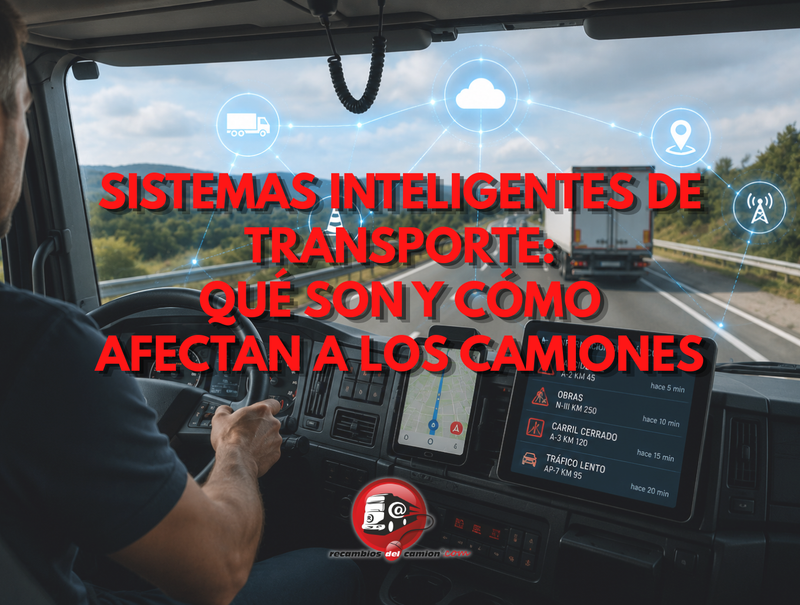
Intelligent Transportation Systems, also known as ITS, are technological solutions that allow the collection, processing, and sharing of information related to mobility. Their purpose is to facilitate better coordination among the different stakeholders involved in transportation.
These systems can include digital traffic platforms, sensors, information panels, mobility applications, connected devices, or real-time information services. In practice, they allow the management and communication of data on road conditions, incidents, closures, restrictions, roadworks, or situations that may affect traffic.
In the case of professional transport, this information can be especially useful. A truck cannot always use any alternative route, as it must take into account weight, height, and length limitations, urban access points, loading and unloading times, or specific restrictions for heavy vehicles.
For this reason, up-to-date information on the road network can help to better plan journeys and anticipate potential incidents along the route.
One of the main points of the new regulatory framework is the exchange of real-time information between administrations, operators, and infrastructure managers. The DGT (Spanish Directorate General of Traffic) indicates that the new regulations aim to improve traffic management, passenger information, and the efficiency of transport services.
The data integrated into this ecosystem includes information such as traffic conditions, road or lane closures, restrictions, roadworks, road obstacles, events, and sporting competitions.
For road freight transport, having this information can be relevant when organizing routes, anticipating potential delays, or adapting journeys when incidents occur. The regulations do not, in themselves, change the way transport companies work, but they are part of a trend toward more connected and data-driven mobility.
National Access Points are also mentioned, which will function as digital infrastructures for sharing mobility and transport information.
These include the National Traffic and Mobility Access Point, managed by the DGT (Spanish Directorate General of Traffic), and the Safe and Protected Parking Zones for heavy goods vehicles, managed by the Ministry of Transport and Sustainable Mobility. This latter point may be of interest to professional drivers, as rest areas and secure parking are part of the daily operations of heavy goods transport.
The new regulation also refers to connected technologies such as the DGT 3.0 platform, the connected V16 beacon, connected cones, and connected tow trucks.
According to the DGT (Spanish Directorate General of Traffic), these tools are part of a mobility system in which different elements can communicate with traffic management centers to facilitate a faster response to incidents on the road.
The connected V16 beacon is one of the best-known examples. This device allows drivers to signal a breakdown or accident and communicate the location of a stopped vehicle. In the case of heavy goods vehicles, correctly signaling an incident is especially important due to the size of the vehicle and the risk that a stop can pose on certain roads.
In addition to the beacon, other connected elements can contribute to improving the information available on roadworks, obstacles, broken-down vehicles, or roadside assistance interventions.
Although this regulation focuses on the digitalization of mobility, it also reflects a clear evolution in road transport: vehicles and infrastructure are becoming increasingly connected.
In the case of trucks, this trend coexists with the usual maintenance needs. Brakes, tires, lighting, batteries, electrical systems, signaling, and safety components remain fundamental for safe driving.
For workshops, carriers, and fleet managers, the technological evolution of the sector means paying attention to both regulatory changes and vehicle maintenance. Digital systems can provide more information, but the vehicle's condition remains a basic factor for safety and efficiency on the road.
Electronics, diagnostics, and connected devices will have an increasingly prominent presence in commercial vehicles. Therefore, truck maintenance depends not only on traditional mechanics but also on the proper functioning of its electrical and safety systems.
The new Intelligent Transport Systems framework confirms that road mobility is moving towards a more digital and coordinated model. For the heavy goods vehicle sector, this means a context in which real-time information will become increasingly important.
Restrictions, incidents, roadworks, road closures, parking areas, connected signage, and digital platforms are all part of an evolution that will progressively affect how traffic and transport services are managed.
For trucking professionals, the key will be to stay informed, be aware of any new developments that may affect traffic, and keep vehicles in good condition to adapt to an increasingly technological environment.
At Truck Parts, we will continue to monitor developments related to road transport, road safety, and the maintenance of commercial vehicles, always with the aim of providing useful information for carriers, workshops, and companies in the sector.
Other related articles
 Aug. 24, 2026
AI-powered cameras in Catalonia: Distraction controls on the A-2 and AP-7
For a professional driver, maintaining their license points and avoiding penalties is … Aug. 5, 2026
Solar eclipse 2026: traffic restrictions update
Traffic restrictions planned for the total solar eclipse on August 12, 2026, … July 22, 2026
2026 Solar Eclipse: Traffic Restrictions and Special Measures
The total solar eclipse of August 12, 2026, will be one of … July 10, 2026
Will breathalyzers be mandatory in 2026? Which vehicles are required to have them?
In recent days, numerous news reports have claimed that, from July 7, … June 9, 2026
Opinions of our clients
Receive our news