Tachographs will be mandatory in vans from 2026: which vehicles will be affected
The use of tachographs in transport vehicles is once again making headlines across Europe. In recent months, numerous headlines have claimed that "vans will be required to have a tachograph from 2026," which has generated a lot of confusion among self-employed drivers, delivery companies, and transport professionals.
The reality is somewhat more specific. The new European regulations do not affect all vans, but only certain vehicles used in international freight transport.
From July 1, 2026, some vans with a maximum authorized mass (MAM) exceeding 2.5 tons will be required to install a second-generation smart tachograph.
This measure is part of the European Union's Mobility Package, a set of reforms created to strengthen the control of road transport within the EU. In this article, we review which vehicles will be affected, what exactly a smart tachograph is, what obligations drivers will have, and why the EU has decided to extend this regulation to certain light vehicles.
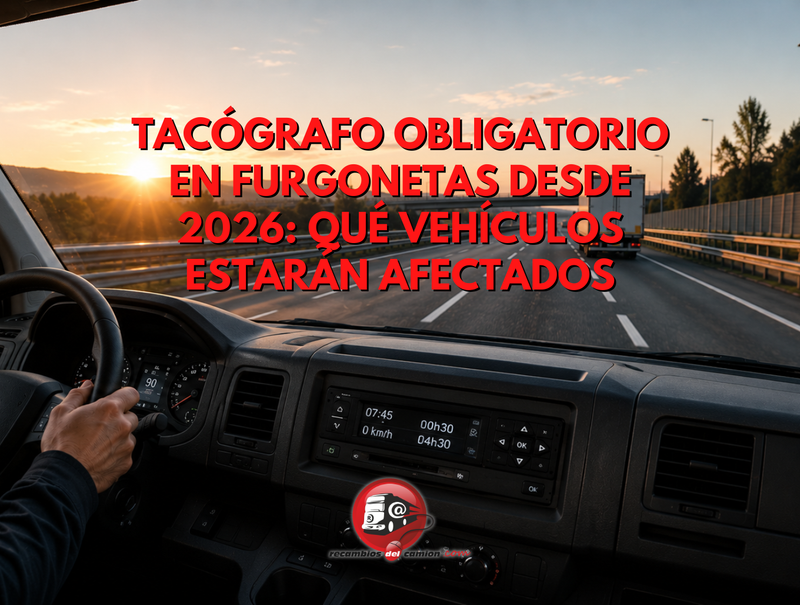
The tachograph is a device that automatically records the driving activity of a commercial vehicle. Its main function is to monitor:
- Driving times
- Mandatory rest periods
- Speed
- Breaks
- The driver's work activity
For years it has been mandatory in most heavy goods vehicles and buses used for commercial transport. Its objective is to improve road safety and prevent excessive driving hours.
With technological advancements, new generations of tachographs have emerged that are capable of recording more information and transmitting certain data remotely to the enforcement authorities.
The so-called second-generation smart tachograph is the most advanced version currently required by the European Union.
This device incorporates additional functions compared to traditional tachographs:
Automatic border recording
The system automatically detects when the vehicle crosses a border between EU countries.
Geolocation
It records the vehicle's position at certain points during the journey using GNSS technology.
Preliminary remote control
Authorities can receive certain data remotely to detect possible tampering or non-compliance before stopping the vehicle.
Loading and unloading recording
In certain operations, logistics activity points can be recorded.
Greater protection against fraud
The new generation incorporates more advanced systems against illegal manipulation.
The European Union has detected significant growth in international transport carried out with light commercial vehicles for years.
Many companies began using vehicles between 2.5 and 3.5 tons for international operations because, until now, they were subject to fewer controls than heavy goods vehicles.
According to the European Commission, this generated several problems:
- Unfair competition
- Excessive driving hours
- Less control of rest periods
- Difficulty in monitoring international operations
- Risks to road safety
For this reason, the Mobility Package partially extends the obligations of professional transport to certain light commercial vehicles as well.
This is where the most confusion lies.
The obligation will NOT apply to all vans.
It will only affect vehicles that simultaneously meet these conditions:
Vehicles over 2.5 tonnes GVWR
The rule applies to light vehicles whose maximum authorized weight exceeds 2.5 tonnes.
Professional goods transport
It must be a professional road transport activity.
International transport
The obligation applies when the vehicle carries out:
- Transport between EU countries
- International operations
- Cabotage
In other words, the key factor is international transport.
Depending on the configuration and approved MMA, some models that could fall within this obligation are:
- Mercedes-Benz Sprinter
- Ford Transit
- Renault Master
- Iveco Daily
- Volkswagen Crafter
- MAN TGE
- Peugeot Boxer
- Citroën Jumper
- Fiat Ducato
However, not all vehicles of these models will be required. Everything will depend on:
- Your specific MMA
- Professional use
- If you carry out international transport
Many professionals will not have to install a tachograph.
For example:
National transport within Spain
A van that only works within Spanish territory is not automatically subject to this European obligation.
Private use
Vehicles used privately are not affected.
Vehicles under 2.5 tonnes GVWR
The regulation does not apply to lighter vehicles.
Local urban delivery
In many cases, national urban delivery will continue to operate without a tachograph requirement.
Another important point is understanding what the EU considers international transport.
It is considered international transport when:
- The vehicle crosses a border between countries
- It transports goods from one Member State to another
- It carries out cabotage operations in another country
For example:
- A Spanish van delivering goods in France
- A Portuguese self-employed worker temporarily working in Spain
- A company operating international routes with light vehicles
What is cabotage?
Cabotage consists of carrying out domestic transport within a country other than the one where the vehicle is registered.
For example:
- A Spanish company delivers goods in France
- Then it carries out several domestic transports within France
This type of operation also falls under European control and may require a tachograph.
The planned date is:
July 1, 2026
From that moment, the affected vehicles must operate with a second-generation smart tachograph installed and operational.
What obligations will drivers have?
Affected drivers must comply with regulations similar to those already in place for heavy goods vehicles.
Among them:
Respecting driving and rest times
The tachograph will record:
- Driving hours
- Breaks
- Daily rest periods
- Weekly rest periods
Using a driver card
It will be necessary to correctly identify oneself on the device.
Keeping records
The authorities may request the data registered.
Facilitate inspections
Checks may be carried out on the road or at company facilities.
Yes. As is currently the case in heavy goods transport, driving without a tachograph when it is mandatory can result in significant financial penalties.
The following may also be penalized:
- Tampering
- Improper use
- Excessive driving hours
- Lack of records
- Failure to comply with rest periods
The amounts will depend on the legislation of each country.
The new regulations may change some aspects of how international light commercial vehicle transport operates.
Higher costs for some companies
There will be expenses related to:
- Tachograph installation
- Maintenance
- Training
- Document management
Greater control over working hours
Companies will need to better organize routes and rest periods.
Equality with heavy commercial vehicle transport
The EU seeks to avoid regulatory differences between trucks and light commercial vehicles used professionally.
Although there is still time until 2026, many companies are already analyzing how to adapt.
It is recommended to:
- Check the maximum authorized mass (MMA) of the vehicles
- Check if they carry out international transport
- Consult with specialized managers
- Find out about type approvals
- Plan for future adaptations
The introduction of the smart tachograph also implies greater professionalization of light transport.
Therefore, it will be even more important to maintain key vehicle components in good condition:
- Electrical system
- Batteries
- Sensors
- Wiring
- Alternator
- Brakes
- Lighting
- Tires
A vehicle subjected to stricter controls will need to minimize breakdowns and guarantee maximum reliability on the road.
The requirement for smart tachographs in vans from July 2026 is real, but it only affects certain vehicles used in professional international transport.
Not all vans will need to be installed. The key will be:
- exceeding 2.5 tons GVW
- carrying out international transport
- operating professionally with goods
The European Union's objective is to strengthen control of the sector, improve road safety, and avoid inequalities between different types of professional transport.
In the coming years, both companies and self-employed individuals will need to prepare for regulations that will bring about a significant change in part of the European light commercial vehicle sector.
Other related articles
 Aug. 24, 2026
AI-powered cameras in Catalonia: Distraction controls on the A-2 and AP-7
For a professional driver, maintaining their license points and avoiding penalties is … Aug. 5, 2026
Solar eclipse 2026: traffic restrictions update
Traffic restrictions planned for the total solar eclipse on August 12, 2026, … July 22, 2026
2026 Solar Eclipse: Traffic Restrictions and Special Measures
The total solar eclipse of August 12, 2026, will be one of … July 10, 2026
Will breathalyzers be mandatory in 2026? Which vehicles are required to have them?
In recent days, numerous news reports have claimed that, from July 7, … June 15, 2026
Opinions of our clients
Receive our news