Snow conditions on the road: What do the DGT colors mean?
Driving in adverse conditions such as snow or ice can pose a significant risk on the roads, especially when the necessary precautions are not taken. The Directorate General of Traffic (DGT) establishes a system of difficulty levels, represented by colors, that helps drivers identify the degree of risk on the roads due to snow. This system is crucial for knowing how to act and when additional measures should be taken, such as installing chains or winter tires.
Below, we explain the different levels of snow according to the DGT, how they affect traffic, and what measures you should take in each of them.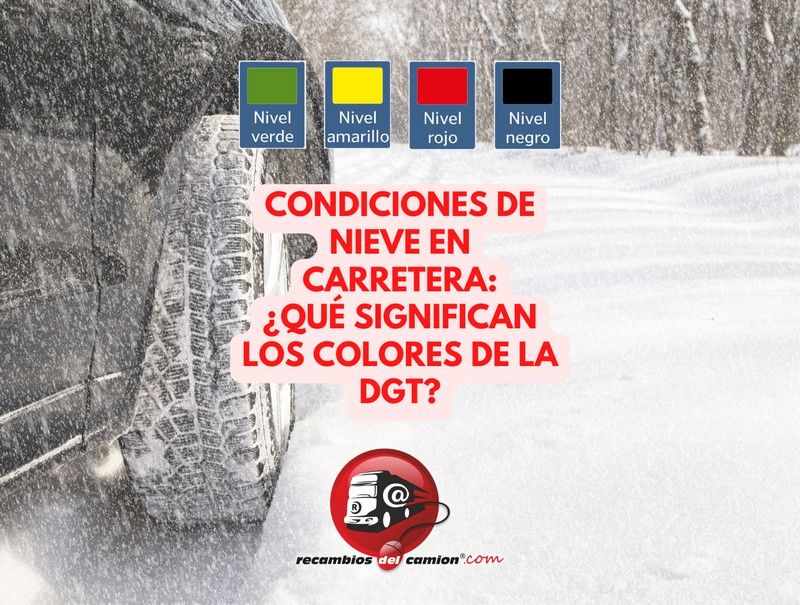
This is the lowest difficulty level and corresponds to when the first snowfalls begin to cover the roads. Although there is no significant accumulation of snow, it is essential to be prepared for changing weather conditions.
- Recommended speed: 100 km/h on motorways and dual carriageways, and 80 km/h on other roads. It is recommended to reduce your speed depending on the specific road conditions and visibility.
- Recommendation: Avoid mountain passes and pay close attention to the weather forecast. Although it is not mandatory, it is recommended to drive with winter or all-season tires if conditions require it.
- Regulations for heavy vehicles: Trucks must drive in the right lane and may not overtake, which helps maintain safe traffic flow.
This level does not usually cause major problems, but it is always important to adjust your driving to the specific conditions at the time.
This level indicates that the snow has accumulated further, partially covering the road and creating more difficult driving conditions. Although the road is still passable, caution is essential.
- Caution: At this level, traffic with trucks and articulated vehicles is prohibited due to the risk of skidding and loss of control.
- Recommended speed: Passenger cars must reduce their speed to 60 km/h. In addition, it is vital to avoid sudden maneuvers and rapid drops in speed, as the roads can be slippery, especially on curves.
- Additional advice:Keep a greater safety distance than usual, as reaction time may be affected due to road conditions.
This level already implies a greater risk, and it is essential to adapt to the new road and visibility conditions.
At the red level, the road is completely covered in snow, and visibility and road grip are significantly reduced. This difficulty level makes driving very risky if appropriate measures are not taken.
- Traffic Prohibition: It is prohibited to drive articulated vehicles, trucks, and buses. This is necessary to prevent larger vehicles from getting stuck or skidding.
- Recommendations:Chains or special snow tires must be used. Speed must be reduced to 30 km/h, and overtaking other stationary vehicles is prohibited.
- Caution:Avoid driving on these sections if you are not properly prepared, as the risk of accidents increases significantly. If you find yourself in this situation, it is advisable to follow alternative routes established by the authorities.
This level requires special attention to safety, both for drivers and road maintenance vehicles.
Black represents the most extreme snow conditions on the roads. At this level, visibility and driving safety are very low, and authorities completely prohibit circulation on the road.
- Traffic Prohibition:The circulation of any type of vehicle is prohibited. If you find yourself trapped in the snow, do not attempt to continue.
- Recommendations if you get stuck:Use the engine heater to keep the interior of the vehicle warm, but do not leave the car if there is no shelter nearby.
- Additional advice:It is crucial not to obstruct the passage of snowplows, so if possible, park as close to the edge of the road as possible to allow the machines to clear the snow without problems.
At this level, the priority is to remain calm and personal safety, hoping that the authorities will manage the situation appropriately.
Regardless of the level of difficulty you encounter on the road, it is essential to follow certain safety guidelines to avoid accidents and ensure the trip is as safe as possible:
- Vehicle preparation:Make sure your vehicle is in good condition before traveling. Check the tires, antifreeze, and brake system. If you are traveling to an area where snow is expected, always carry chains or winter tires.
- Safety distance:Leave more space between your car and the one in front of you to give yourself more reaction time if braking is necessary.
- Driving adaptation:Drive smoothly, avoiding sudden acceleration or braking. Keep your wheels straight when driving over icy surfaces and, if necessary, correct your path with the steering wheel.
- High gears on slippery surfaces: If you're driving on slippery surfaces, use high gears to avoid skidding. If you're going downhill, shift into low gears to maintain control of the vehicle.
Other related articles
 Aug. 24, 2026
AI-powered cameras in Catalonia: Distraction controls on the A-2 and AP-7
For a professional driver, maintaining their license points and avoiding penalties is … Aug. 5, 2026
Solar eclipse 2026: traffic restrictions update
Traffic restrictions planned for the total solar eclipse on August 12, 2026, … July 22, 2026
2026 Solar Eclipse: Traffic Restrictions and Special Measures
The total solar eclipse of August 12, 2026, will be one of … July 10, 2026
Will breathalyzers be mandatory in 2026? Which vehicles are required to have them?
In recent days, numerous news reports have claimed that, from July 7, … June 15, 2026
Opinions of our clients
Receive our news