History of Volvo III trucks (1933-1937)
We continue with the summary of the interesting history of the Volvo brand, focusing on its section dedicated to trucks. In this article we talk about the different novelties of the brand during the years before the 2nd World War and during it, with the incorporation of wood gasifiers due to the lack of gasoline due to the war.
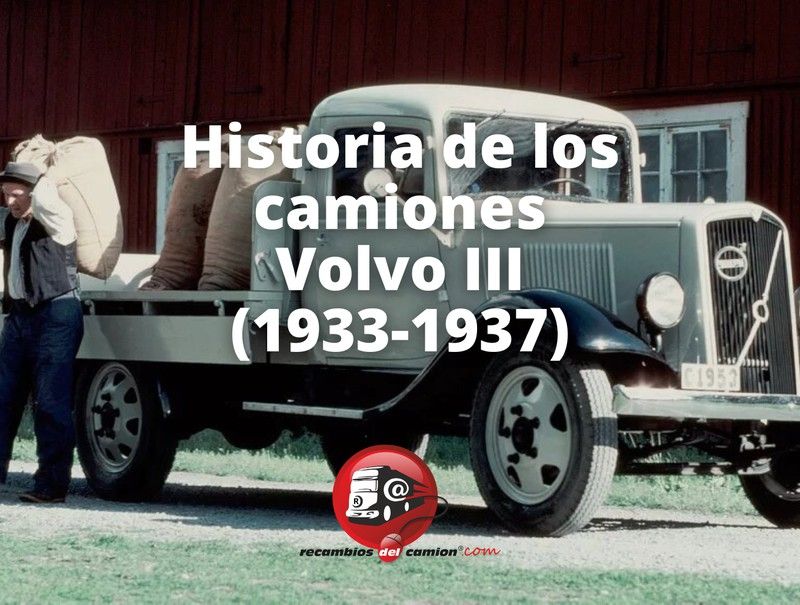
In 1932 the LV71 series with its variants was launched. Models with two different wheelbases (3.4 and 4.1 meters) and two payloads (2.5 and 3 tons) are presented. The buyer could therefore choose between the models LV71 (3.4 meters and 2.5 tons), LV72 (4.1 meters and 2.5 tons), LV73 (3.4 meters and 3 tons) and LV74 (4, 1 meters and 3 tons).
Along with these models, designed to better adapt to the type of work that the truck is going to do, Volvo once again revolutionizes the sector in Europe with the new LV75. This model was the first of the Continent of the Cab-over type (cab above), and it was also a novelty in the United States, where the same year the White Motor Company had presented the first. This type of truck has the peculiarity of doing without the nose, with a completely flat cabin (called flat face, flat nose or semi-coffer). To achieve this, the driver was located next to the engine and not the gearbox, as in conventional trucks. In this way, a better weight distribution between the two axes is achieved.
In 1934, two years after introducing the mid-size truck range, the LV71, Volvo introduces its new light truck range, the LV76.
Initially it included three models, differentiated by their payload: the LV76 with a 1-tonne payload, LV77 with a 1.25-tonne payload and LV78 with a 1.5-tonne payload.
Subsequently, in 1935, important improvements were made to the range, such as a new radiator cover, which takes aerodynamics into account. In addition, the LV79 is included in the range, designed to be more resistant than the rest of the trucks in the family.
With the war came the rationing of fossil fuels and the whole of Europe began to incorporate wood gasifiers in their vehicles in order to continue using them.
The wood gasifier, invented by Gustav Bischof in 1839, can power a gasoline or diesel engine with minor mechanical changes. The gases produced by burning wood in the gasifier become the fuel that drives the combustion engine.
Sweden was the country that used this fossil fuel substitute the most, reaching more than 73,000 adapted vehicles in 1942. Volvo included gasifiers as an option on its LV79 from 1940, with a loss of 25 CV compared to to the same engine powered by gasoline, going from 75 CV to 50 CV.
Keep learning about Volvo's history in the following article: History of Volvo IV trucks (1937-1950)
Other related articles
 Aug. 24, 2026
AI-powered cameras in Catalonia: Distraction controls on the A-2 and AP-7
For a professional driver, maintaining their license points and avoiding penalties is … Aug. 5, 2026
Solar eclipse 2026: traffic restrictions update
Traffic restrictions planned for the total solar eclipse on August 12, 2026, … July 22, 2026
2026 Solar Eclipse: Traffic Restrictions and Special Measures
The total solar eclipse of August 12, 2026, will be one of … July 10, 2026
Will breathalyzers be mandatory in 2026? Which vehicles are required to have them?
In recent days, numerous news reports have claimed that, from July 7, … June 15, 2026
Opinions of our clients
Receive our news