Driving license from age 17: requirements and how accompanied driving works
Traffic regulations in Europe continue to evolve to adapt to new social, technological, and road safety realities. One of the most significant developments in recent years is the introduction of supervised driving from the age of 17, a measure included in European Directive 2025/2205 that will mark a turning point in how young people obtain a driver's license.
According to data from the Spanish Directorate General of Traffic (DGT), this legislative change aims not only to facilitate access to driving but also to improve road safety through a progressive and supervised model.
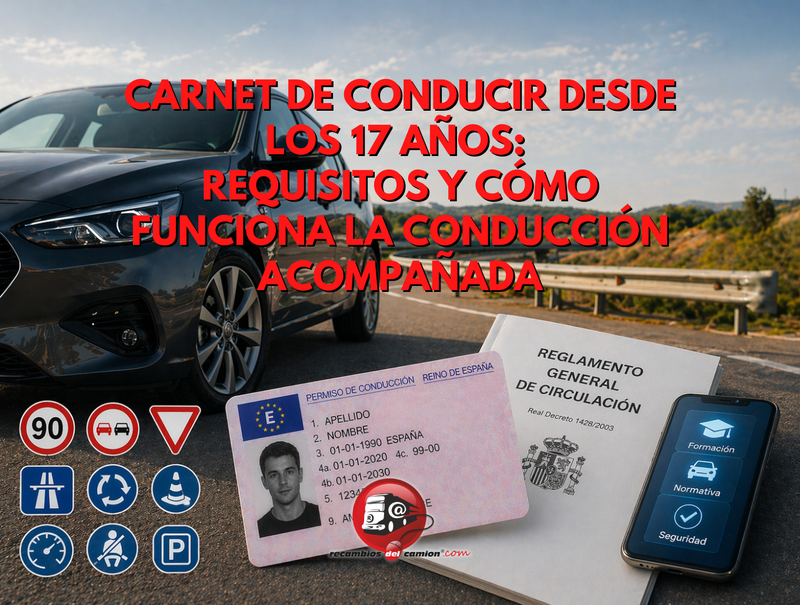
European Directive 2025/2205, approved last November, introduces the possibility for 17-year-olds to obtain a Class B driving license. However, this authorization comes with a fundamental condition: they cannot drive alone until they turn 18.
During this period, the novice driver must always be accompanied by an experienced person, who will occupy the passenger seat and act as a guide while driving.
This model, known as the “German model,” has already shown good results in other European countries, combining practical learning with real-world supervision on the road. As Montserrat Pérez, Deputy Director General of Training and Road Safety Education at the DGT (Spanish Directorate General of Traffic), explains, this license will include a specific code (98.02) indicating the mandatory requirement for accompanied driving until the age of majority.
Although the measure has already been approved at the European level, each country must adapt it to its national legislation.
In the case of Spain, the deadline for its transposition is November 26, 2028, and the DGT (Spanish Directorate General of Traffic) is already working on it.
The main objective of this initiative is clear: to reduce the risks associated with inexperience behind the wheel. Accompanied driving allows young people to gain experience in real-life situations, but under the supervision of an experienced driver.
According to the Directive itself, this system aims to ensure that learning does not end upon passing the exam, but continues under controlled conditions during the first months of driving.
Furthermore, this approach introduces a key element: shared responsibility. Not only must the young driver comply with the rules, but also their companion, who becomes an essential figure in the learning process.
Not just anyone can act as a passenger. European regulations establish a series of strict conditions to ensure that this role is fulfilled properly.
Among the main requirements are:
- Being at least 24 years of age
- Holding a valid driving license of the same category (Class B)
- Having obtained said license at least five years prior
- Not having been disqualified from driving in the last five years
- Strictly complying with the rules regarding alcohol and drug use
In addition, the Directive allows each Member State to establish additional conditions or even limit the number of passengers per driver.
Ultimately, it is not just about “riding alongside,” but about assuming active responsibility as a role model while driving. The passenger must be an example in behavior, attitude, and respect for traffic laws.
From an educational standpoint, there are no changes to the process for obtaining a license. Applicants must follow the same path as before: theoretical training, practical lessons, and passing both exams.
As the DGT (Spanish Directorate General of Traffic) points out, the Directive does not modify the educational model, but rather regulates aspects such as exam content, time limits, and examiner requirements.
This means that 17-year-olds must demonstrate the same level of knowledge and skills as any other driver before getting behind the wheel, even if they do so under supervision.
The introduction of this system brings benefits both individually and socially. Among the most notable:
Greater experience before driving alone
Young people accumulate real driving hours in different environments, which reduces insecurity when they turn 18.
Reduced risk of accidents
Constant supervision helps correct mistakes and encourages more cautious driving from the start.
Facilitates mobility in rural areas
According to the DGT (Spanish Directorate General of Traffic), this measure can be especially useful for young people who live in areas with few transport alternatives.
Preparation for new stages
Many young people will be able to enter university or the workforce with prior driving experience.
In the case of heavy goods vehicles, such as trucks, the implementation of accompanied driving has been one of the most debated aspects during the drafting of European Directive 2025/2205. According to data from the Spanish Directorate General of Traffic (DGT), several countries proposed this option as a possible way to address the growing shortage of professional drivers in Europe, a problem that directly affects the transport sector. However, there was no consensus, and a flexible solution was ultimately chosen.
The regulations stipulate that each Member State will decide whether or not to allow this model for Group 2 licenses. If implemented, it would only be valid within that country. Spain, for its part, has opted for a cautious stance and, at least for now, is ruling out this possibility. The reason is clear: driving trucks requires a much higher level of responsibility, experience, and training, both due to the size and characteristics of the vehicle and the specific demands of professional transport.
Thus, accompanied driving remains, for the time being, limited to passenger cars.
Even so, the sector will continue to closely monitor how these policies evolve in the coming years, especially in a context where the generational change of drivers has become one of the major challenges in road transport.
Beyond accompanied driving, Directive 2025/2205 includes a series of recommendations on road safety. And here, according to the DGT (Spanish Directorate General of Traffic), Spain has an advantage.
Many of the proposed measures are already implemented in our country, such as:
- The inclusion of ADAS systems in theoretical and practical training
- Road safety education in schools
- Safe and efficient driving courses for experienced drivers
This demonstrates that the Spanish model is aligned with European trends and that the foundations for road safety are solid.
The Directive also introduces changes related to sustainability and the ecological transition. Among them, the expansion of the possibilities for driving vehicles powered by alternative fuels with greater mass stands out.
Specifically, it will be permitted to drive vehicles up to 4,250 kg, provided they meet certain requirements and after two years of experience.
This change reflects a reality: vehicles are evolving, especially with electrification, and regulations must adapt to this.
Accompanied driving at age 17 represents a significant change in access to a driver's license in Europe. It's not simply about lowering the age, but about introducing a more progressive, safer model adapted to current needs.
With the support of organizations like the DGT (Spanish Directorate General of Traffic), this measure aims to train more prepared, responsible, and conscientious drivers from the outset.
We will have to wait for its full implementation in Spain, but everything suggests that it will mark a new era in road safety education and in how young people understand driving.
Other related articles
 Aug. 24, 2026
AI-powered cameras in Catalonia: Distraction controls on the A-2 and AP-7
For a professional driver, maintaining their license points and avoiding penalties is … Aug. 5, 2026
Solar eclipse 2026: traffic restrictions update
Traffic restrictions planned for the total solar eclipse on August 12, 2026, … July 22, 2026
2026 Solar Eclipse: Traffic Restrictions and Special Measures
The total solar eclipse of August 12, 2026, will be one of … July 10, 2026
Will breathalyzers be mandatory in 2026? Which vehicles are required to have them?
In recent days, numerous news reports have claimed that, from July 7, … June 15, 2026
Opinions of our clients
Receive our news