Can you be fined for misusing the V-16 beacon? Here's what the DGT says
From January 1, 2026, traffic regulations in Spain will undergo a significant change: the connected V-16 beacon will be mandatory for all vehicles that need to signal a roadside emergency. This device replaces the old emergency triangles, providing greater safety, as it is not necessary to leave the vehicle to place it.
However, its misuse can also result in penalties. Many drivers are unaware that using this beacon incorrectly, or in inappropriate contexts, can lead to fines of up to €200 or even more in serious cases. In this article, we explain when and how to use it correctly, when you can be fined, and what measures to take to avoid penalties.
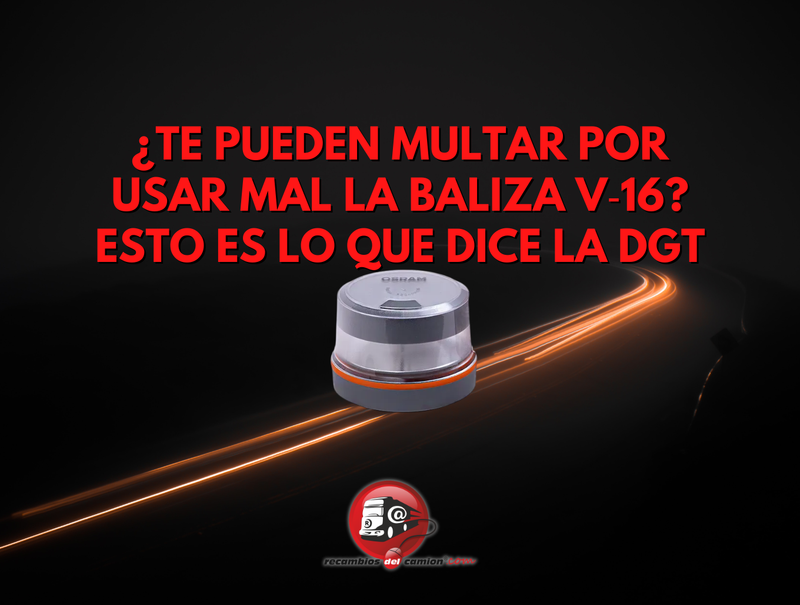
The V-16 beacon is a luminous device that is placed on the roof of the vehicle in case of emergency. It emits a flashing yellow light visible in 360 degrees, allowing the position of the immobilized vehicle to be signaled without the driver having to get out of the car or truck.
Furthermore, the approved version connected to the DGT 3.0 system automatically sends the vehicle's location to the Directorate General of Traffic, helping to manage traffic and prevent accidents.
The regulations state that:
- Its use was voluntary from July 2021.
- From January 1, 2026, it is mandatory and completely replaces the warning triangles.
It's not enough to have the beacon in your vehicle. Misusing it can also get you into trouble. These are the most common situations that can lead to a fine:
1. Activating the beacon to park illegally or double-park
One of the most frequent misuses is using the beacon as an excuse to park illegally, in prohibited areas, or temporarily block lanes. Although some drivers do this thinking it's harmless, this use is expressly prohibited.
➡️ Estimated fine: €200
2. Faking a breakdown to rest
Parking on the shoulder and turning on the beacon to sleep or rest may seem like a quick solution, but it's not allowed. It can only be used in a real emergency or breakdown.
➡️ Estimated fine: €200
3. Using the beacon in private areas or off public roads: Here are some nuances: if you test the beacon in your garage, a private parking lot, or at your home, you cannot be fined, as you are not on a public road. The DGT (Spanish Directorate General of Traffic) has taken this into account and has developed filters in the system that ignore these test signals. ➡️ Fine: none, as long as you are not on a public road. 4. Simulating an accident or issuing false alerts: This is much more serious. If someone activates the beacon to simulate an accident or deceive the authorities, they may face more severe penalties. This is a serious offense that can have additional legal consequences. ➡️ Fine: can exceed €500 and even have criminal consequences if there is intent to defraud.
In addition to misuse, you can also be penalized if:
- You do not carry an approved and connected V-16 beacon
Since January 2026, it has been mandatory for the beacon to be approved by the DGT and connected to the DGT 3.0 system. Old (unconnected) beacons are no longer valid after that date.
➡️ Estimated fine: €80
- Failure to use it in a genuine breakdown
If you have a breakdown or accident and do not use any signaling system, you are breaking traffic regulations and endangering other road users.
➡️ Estimated fine: from €100 upwards, depending on the danger created.
- Use of a beacon that is not visible or is in poor condition
If your beacon is not working correctly, has no battery, or is incorrectly positioned and not visible, you can also be fined.
➡️ Estimated fine: €80 – €200, depending on the severity
This is one of the hoaxes that have been circulating recently. Although some headlines mention fines of up to €30,000, the reality is that this figure is only applied in very serious cases, related to simulating emergencies, fraud, or intentionally endangering road safety.
For everyday misuse, such as activating the hazard lights to park illegally, fines are usually around €200. However, the DGT (Spanish Directorate General of Traffic) can increase the fine if it considers that there has been a serious infraction or a repeat offense.
Yes. You can test the beacon as many times as you like off public roads, as long as you don't activate it repeatedly or generate unnecessary alerts.
The DGT (Spanish Directorate General of Traffic) has confirmed that activations in locations not linked to public roads are neither penalized nor recorded. Furthermore, approved models allow you to deactivate the signal before it is sent to traffic authorities, in case you accidentally turn it on by mistake.
Before 2026, many models did not meet all the requirements. Since the regulations came into effect, only beacons that meet the following requirements are valid:
- Are approved by the DGT (LCOE or IDIADA code visible).
- Are connected to the DGT 3.0 system via an integrated card.
- Operate autonomously, without depending on mobile phone coverage.
- Have a battery with at least 18 months of autonomy.
- Are resistant to water and extreme temperatures.
Carrying a non-approved beacon can not only result in a fine, but also fails to fulfill the legal obligation.
✔ Purchase an approved and connected V-16 beacon. Verify that it is on the official DGT (Spanish Directorate General of Traffic) list.
✔ Store it in an accessible location inside the cab of your truck or car.
✔ Check the battery regularly. Some beacons allow you to check their status via an app.
✔ Do not use it as an excuse for illegal parking or simulating an emergency.
✔ If you have a real emergency, activate it as soon as possible without leaving your vehicle.
The installation of the V-16 warning light is not only a legal requirement from 2026: it's a key tool for improving road safety. Using it correctly protects your life and the lives of other drivers. It also helps you avoid fines and legal problems.
At Truck Parts, we work to ensure all our customers are informed and equipped with the best products for their road safety. If you don't yet have your V-16 warning light connected and approved, don't wait any longer. Avoid risks and fines!
Other related articles
 Aug. 24, 2026
AI-powered cameras in Catalonia: Distraction controls on the A-2 and AP-7
For a professional driver, maintaining their license points and avoiding penalties is … Aug. 5, 2026
Solar eclipse 2026: traffic restrictions update
Traffic restrictions planned for the total solar eclipse on August 12, 2026, … July 22, 2026
2026 Solar Eclipse: Traffic Restrictions and Special Measures
The total solar eclipse of August 12, 2026, will be one of … July 10, 2026
Will breathalyzers be mandatory in 2026? Which vehicles are required to have them?
In recent days, numerous news reports have claimed that, from July 7, … June 15, 2026
Opinions of our clients
Receive our news