V16 Beacon: Mandatory requirement confirmed amid invalid models and a DGT that acknowledges its shortcomings
The V16 connected beacon was conceived as a simple solution: to eliminate the need to go down to the road to place warning triangles and reduce the risk of pedestrian accidents in emergency situations. A small device, visible from long distances, capable of automatically alerting the traffic system when a vehicle becomes immobilized. On paper, a clear and logical improvement in road safety.
However, the transition to this new system is proving far more turbulent than expected. As January 1, 2026, approaches, the number of doubts, incorrect purchases, controversies, criticisms, and complaints continues to grow.
Consumer organizations are warning of thousands of beacons that have been sold despite not being valid for the new mandatory requirement, users discovering too late that what they bought is useless, transport companies worried about the cost of renewing entire fleets, and a DGT (Spanish Directorate General of Traffic) that has had to publicly acknowledge that the communication of the change was inadequate. In this article, we clearly explain everything that is happening and, above all, what every driver should do to comply with the regulations without making mistakes.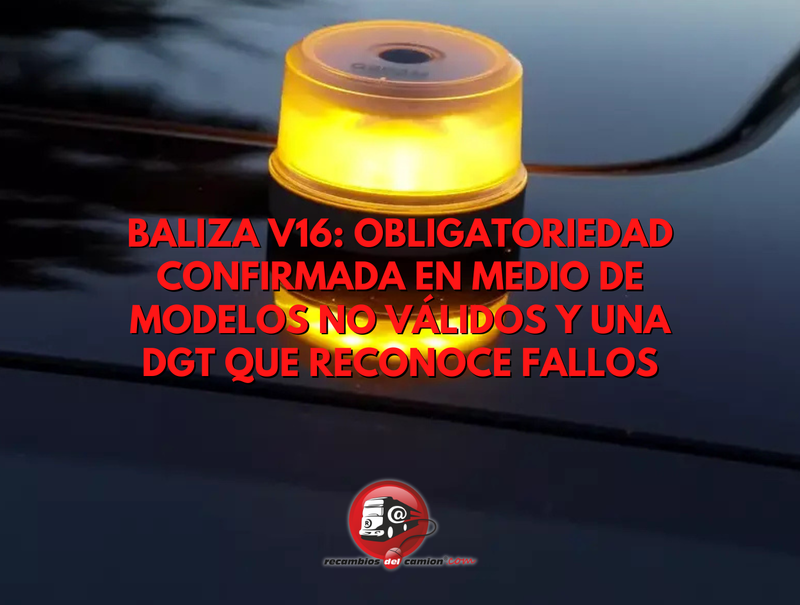
The first thing to be absolutely clear about is that the DGT (Spanish Directorate General of Traffic) has ruled out any extension. After weeks of rumors and confusion, the agency confirmed that the date is fixed: from January 1st, the connected V16 beacon will be the only valid device for signaling a vehicle stopped on the road.
This makes the transition an urgent matter for millions of drivers and, especially, for the entire transport sector. Warning triangles are definitively a thing of the past. Although they can still be stored in the vehicle, they will no longer be legally valid.
The DGT's announcement has been firm because, according to its officials, the administration believes there has been enough time to adapt. But this assertion has clashed head-on with market realities and public perception, as people haven't always known what they should buy.
Along with the mandatory requirement, the DGT (Spanish Directorate General of Traffic) and the Guardia Civil (Spanish Civil Guard) have clarified another important point: not carrying a connected and approved V16 beacon will be punishable by law.
However, officers will apply some flexibility during the first weeks of 2026.
This initial window will be used to inform the public, explain the regulation, and answer questions. However, this flexibility on the part of the officers does not eliminate the actual obligation: the beacon must be in the vehicle from the first day of the year, and the penalty will be effective once this information period has passed.
In other words: don't be complacent. The V16 is not optional, its mandatory nature is not being debated, and there are no plans to delay it. It is a requirement that comes into effect now.
The most critical point in this whole story is not the standard itself, but what has happened in the market.
During the last few years, V16 beacons have been sold that seemed to be the solution to the mandatory future, but which were only valid during the transition period.
They do not include connectivity, an essential requirement for 2026.The problem has been that many retailers:
- Have continued selling these models without explaining that their validity ends in 2025.
- Have used expressions like “V16 approved” without clarifying that this approval is not final.
- Have created the impression that any V16 beacon was valid forever.
The result is that thousands of people believed they had complied with the regulations… when in reality they had bought something that, in a matter of days, will cease to function.
This problem is compounded in companies that purchased entire batches for a whole fleet and now must replace each unit with a connected model.
Given this situation, FACUA has intervened decisively. The organization believes that a serious situation of confusion has arisen for consumers and denounces what it calls a “massive fraud”: beacons sold as valid without clarifying that they are not suitable for the mandatory 2026 requirement.
FACUA accuses the DGT (Spanish Directorate General of Traffic) of not having acted firmly enough to prevent these products from continuing to be marketed without clear warnings. Furthermore, it issues a direct recommendation to those affected:
Claim a refund if the purchased beacon does not include connectivity or does not comply with the final regulations.
Many consumers are unaware that they have the right to do so if the product information was ambiguous or incomplete.
Amid the controversy, the DGT (Spanish Directorate General of Traffic) has publicly acknowledged that the implementation of the V16 system has not been managed correctly. This is an unusual statement, but one that reflects the magnitude of the problem.
The acknowledged shortcomings are focused on three fronts:
1. Lack of clear communication
Although the regulations had been defined for years, the information did not reach users adequately. It was not clearly explained which beacons would cease to be valid and which were the final ones.
2. Confusing messages that led to incorrect purchases
For a long time, the term "approved" was used without differentiating between temporary and final approval. The result: thousands of incorrect purchases.
3. Delayed response to misinformation
Rumors spread before the DGT (Spanish Directorate General of Traffic) clearly and repeatedly refuted them, leaving drivers uncertain and distrustful.
The administration itself acknowledges that this has contributed to the current situation.
The lack of clarity is compounded by misinformation. In practice, the V16 has suffered a disinformation campaign that has generated fear or rejection among some drivers.
- The most widespread rumors claimed that:
- The beacon tracks the vehicle 24 hours a day.
- It sends the driver's personal data.
- It will allow for automatic fines based on location.
- It works like a GPS even when turned off.
- Connectivity requires an annual payment.
None of this is true.
The beacon only transmits its location when activated by an emergency and does not link that information to an identity or a route. The necessary connectivity is included from the factory.
But, since the DGT (Spanish Directorate General of Traffic) was late in denying these rumors, a portion of the population continues to distrust the device.
For an individual, buying the wrong beacon is annoying.
For a transport company, it can be a serious problem.
Many fleets bought unconnected beacons months ago thinking they already met the future requirement. Now they must acquire new units and reorganize their entire internal operations.
Furthermore, in commercial vehicles, beacon placement requires different planning: the vehicle's height and environmental conditions necessitate driver training to avoid risks during signaling.
Managing V16 in fleets involves:
- Checking models and connectivity dates.
- Ensuring each vehicle has a valid beacon.
- Reviewing functionality periodically.
- Avoiding impulse purchases in a saturated market.
To avoid any errors, a V16 beacon valid for 2026 must:
- Have integrated connectivity, not optional connectivity.
- Be approved according to the final regulations, not the temporary ones.
- Clearly display the certification code.
- Appear on the official list of authorized models.
- Include the connectivity duration guaranteed by the manufacturer.
If a beacon does not meet these requirements, it will not be valid from January 1st.
With the change just a few weeks away, it's best to act decisively:
- Check if your existing beacon is connected.
- Replace it as soon as possible if it doesn't comply with the final regulations.
- Avoid hasty purchases that don't clearly indicate their final approval.
- In fleets, check each vehicle individually without waiting until the last minute.
You still have time to comply with the regulation without problems, but it's advisable to act now.
To facilitate the transition, we offer two fully approved V16 connected beacon models, with built-in connectivity and valid for compliance with regulations from January 1, 2026.
If you need advice or want to choose the most suitable option for your vehicle or fleet, we can help you.
Other related articles
 Aug. 24, 2026
AI-powered cameras in Catalonia: Distraction controls on the A-2 and AP-7
For a professional driver, maintaining their license points and avoiding penalties is … Aug. 5, 2026
Solar eclipse 2026: traffic restrictions update
Traffic restrictions planned for the total solar eclipse on August 12, 2026, … July 22, 2026
2026 Solar Eclipse: Traffic Restrictions and Special Measures
The total solar eclipse of August 12, 2026, will be one of … July 10, 2026
Will breathalyzers be mandatory in 2026? Which vehicles are required to have them?
In recent days, numerous news reports have claimed that, from July 7, … June 15, 2026
Opinions of our clients
Receive our news