DGT's smart speed cameras: all the traffic violations they can now detect
The Spanish Directorate General of Traffic (DGT) is reinforcing its surveillance systems with increasingly advanced technology. Although many speak of “speed cameras that monitor everything,” the reality is somewhat more nuanced: it is not a single device capable of detecting all infractions, but rather a combination of different systems that allow for monitoring aspects such as mobile phone use or seat belt use. This evolution, which is already being implemented on Spanish roads, represents a significant change for drivers, especially for professional transport drivers.
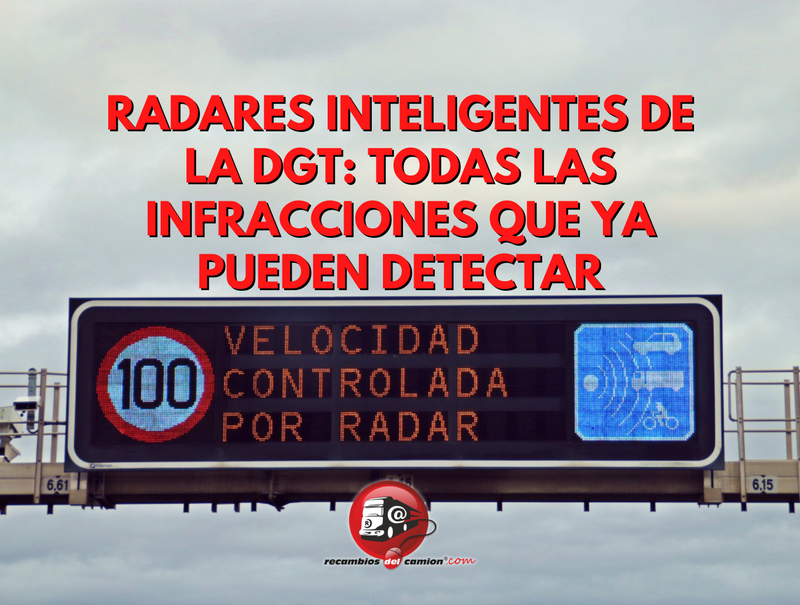
In recent years, the Spanish Directorate General of Traffic (DGT) has intensified its efforts to improve road safety on Spanish roads. In this context, more advanced control systems are being incorporated that go beyond traditional speed cameras.
Until now, most drivers associated these devices with speeding tickets. However, enforcement has evolved: the DGT is combining different types of radar and cameras capable of detecting other infractions, such as mobile phone use or failure to wear a seatbelt.
For truck drivers, this new scenario means greater control and, above all, less room for error, especially on frequently used routes where these systems are already in place.
The main improvement in the DGT's surveillance systems lies in the combination of technologies: traditional radars, high-resolution cameras, and image analysis tools. This allows for the detection of certain infractions without the need for direct intervention by officers on the road.
Mobile phone use while driving
One of the main areas of focus for monitoring is mobile phone use while driving. Roadside cameras can clearly detect if the driver is manipulating the device, even in tall vehicles like trucks. This is one of the most frequently prosecuted infractions today, due to its direct link to accidents caused by distraction. Not wearing a seatbelt: These systems also allow checks to be made if the driver is wearing their seatbelt correctly. In the case of transport companies, where short journeys or repetitive maneuvers are sometimes carried out, this type of oversight can result in a fine. Improper use of lanes: Lane usage monitoring is not a standard feature of speed cameras. In these cases, surveillance is carried out using specific cameras or through the presence of officers, especially in restricted areas or reserved lanes. This is particularly relevant for heavy goods vehicles on urban access roads or roads with limitations. Vehicle Documentation Check: The DGT (Spanish Directorate General of Traffic) can also automatically check if a vehicle has a valid ITV (Spanish MOT) or active insurance, but not through the radar itself. This check is performed by cross-referencing the license plate with official databases. This allows for the detection of administrative irregularities without needing to stop the vehicle.
To better understand this change, it's important to know the different devices that are already in operation or being expanded. They don't all perform the same function, and many work in a complementary way.
Fixed Speed Cameras
These are the traditional devices installed at specific points on the road network. Their main function remains measuring vehicle speed.
Some of these points may be accompanied by additional cameras that capture images of the vehicle, but not all fixed speed cameras detect other infractions besides speeding.
Average Speed Cameras
These cameras calculate the average speed of a vehicle between two points by reading the license plate.
Their function is exclusively that: to ensure that the speed limit is not exceeded on that section of road.
They do not record behaviors such as mobile phone use or seatbelt failure.
Surveillance Cameras
These are independent devices from speed cameras. These cameras, located at different points along the road, can detect infractions such as mobile phone use or not wearing a seatbelt.
Some use image analysis systems to automate detection, although their implementation is not uniform across the entire network.
Mobile Speed Cameras
The DGT (Spanish Directorate General of Traffic) also uses mobile speed cameras, installed in vehicles or on tripods, which allow for speed monitoring at different points on a case-by-case basis.
These devices can be complemented by the work of officers, who are the ones who detect other traffic violations.
The placement of the DGT's surveillance devices is part of a clear strategy: to increase safety at the most problematic points on the road network.
The main areas where these systems are being reinforced are:
- Conventional roads with high accident rates
- Access roads to large cities
- Sections with high traffic volume
- Areas where traffic violations are frequently repeated
Rather than focusing on new locations, the current trend is to intensify and expand controls at key points.
For freight transport, this means that many common routes are now under more constant surveillance.
With the reinforcement of roadside enforcement systems, it's worth remembering the penalties associated with the most common traffic violations.
- Using a mobile phone while driving: €200 fine and 6 points deducted
- Not wearing a seatbelt: €200 fine and 4 points deducted
- Speeding: penalties vary depending on the speed limit exceeded
- Expired vehicle inspection (ITV) or driving without insurance: potentially high fines
Increased surveillance, through radar, cameras, and automated checkpoints, makes it increasingly difficult to overlook these types of violations.
Professional drivers are among the groups most exposed to these changes. Spending many hours behind the wheel increases the likelihood of making mistakes, and with increased roadside surveillance, any lapse in concentration can have consequences.
There are several key aspects to consider:
- Current cameras allow for a fairly clear view inside the cabs, even in tall vehicles
- Mobile phone use during long journeys is increasingly monitored
- Administrative checks, such as vehicle inspections and insurance verification, are carried out more efficiently using automated systems
All of this makes it essential to exercise extreme caution and maintain responsible driving at all times.
Adapting to the enhanced enforcement of traffic control systems is essential, especially in the transport sector. Some practical tips can make all the difference:
Avoid using your mobile phone
Use hands-free systems only when absolutely necessary and never operate the device while driving.
Always check your seatbelt
Make sure it is properly fastened, even on short journeys or within logistics zones.
Keep your documentation up to date
Regularly check that your vehicle has a valid MOT/roadworthiness certificate and active insurance.
Respect lanes and traffic signs
Especially in urban areas or areas with restrictions for heavy goods vehicles.
Plan your routes
Knowing the most heavily monitored sections can help you anticipate potential issues and drive with greater peace of mind.
Strengthening roadside traffic control systems has a direct impact on the logistics sector. Transport companies will need to improve driver training and commit to safer and more efficient driving.
Furthermore, this increased surveillance can contribute to:
- Reducing work-related road accidents
- Improving the sector's image
- Decreasing costs associated with fines
In the long term, technology applied to traffic control can become an ally in further professionalizing road transport.
Although many drivers perceive these measures as increased enforcement, the main objective is clear: to reduce road accidents.
Distracted driving, especially mobile phone use, has become one of the leading causes of accidents. Therefore, the DGT (Spanish Directorate General of Traffic) is committed to strengthening surveillance systems and using technologies that allow for more effective detection of these behaviors.
The evolution of traffic control systems marks the beginning of a new era in roadside surveillance. Technology will continue to advance, and improvements to these devices are expected in the coming years.
For drivers, and especially for transport professionals, the key will be adapting as quickly as possible to this increasingly controlled environment.
Driving responsibly is no longer just a matter of safety, but also the best way to avoid penalties in a context of ever-increasing surveillance.
Other related articles
 Aug. 24, 2026
AI-powered cameras in Catalonia: Distraction controls on the A-2 and AP-7
For a professional driver, maintaining their license points and avoiding penalties is … Aug. 5, 2026
Solar eclipse 2026: traffic restrictions update
Traffic restrictions planned for the total solar eclipse on August 12, 2026, … July 22, 2026
2026 Solar Eclipse: Traffic Restrictions and Special Measures
The total solar eclipse of August 12, 2026, will be one of … July 10, 2026
Will breathalyzers be mandatory in 2026? Which vehicles are required to have them?
In recent days, numerous news reports have claimed that, from July 7, … June 15, 2026
Opinions of our clients
Receive our news