The problems of hydrogen and electric trucks
We have already spoken to you on occasion about models of electric and hydrogen trucks. Today we talk about the challenges of this change towards greener fuels and everything that remains to be done.
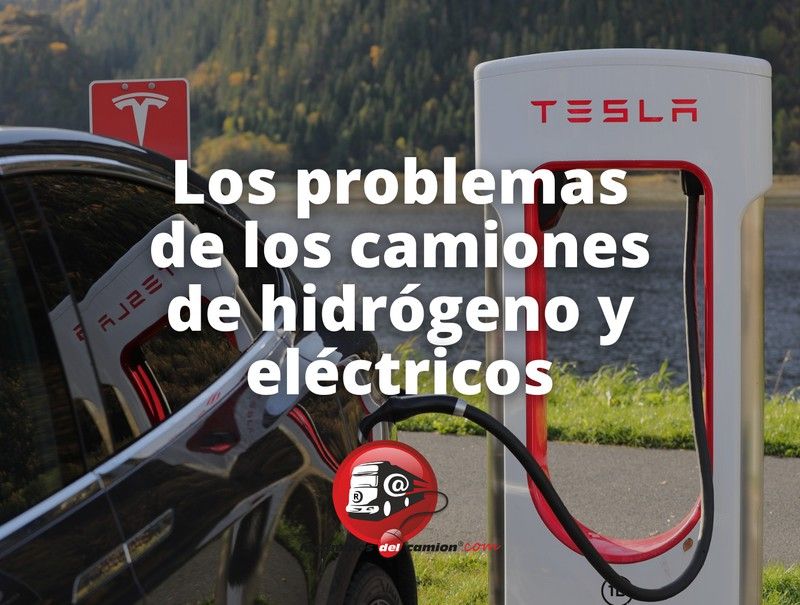
The European trucking industry is already heading towards a future that is at least partially decarbonised. While we need trucks that carriers and businesses can buy or lease, we also need special infrastructure to charge large batteries and fill large hydrogen tanks.
It is not clear whether electric or electric truck technologies with hydrogen fuel cells and batteries are ideal for any application. A priori, hydrogen has established itself as the best alternative for long-distance travel. Truck drivers don't have to stop as long, and it's a significant weight savings compared to large batteries.
If these technologies have anything in common in terms of infrastructure, it's that they're largely undeveloped. Logistics companies that have started using electric trucks must, with their means, solve the problem of refueling or charging batteries and do not depend on facilities that rarely exist or cannot be expected in a short period of time.
Currently the best positioned manufacturer in this regard is Mercedes-Benz, whose truck division has been spun off from the passenger car division, and there is already a model on the market, the eActros. Mass production began in late November. There is also a hydrogen prototype (GenH2 truck) that was approved by the regulatory agency in October.
Daimler Trucks has a contract with BP to build a hydrogen tank infrastructure and is working with Volvo to produce this type of truck.
Nikola and IVECO will complete their plant shortly and soon they will produce an electric truck based on the Italian SWAY in Germany. Irizar was also part of the party and presented its electric truck.
Traton, a truck subsidiary of the Volkswagen Group that integrates MAN and Scania, is working with Toyota through the Hino brand. Traton does not believe in hydrogen and bets on electric trucks, but the Japanese are aware of the viability of hydrogen in large transports.
Tesla will make the first delivery of semi-trailers in the United States, starting with PepsiCo. Additionally, Volta has announced an order for 1,470 Zeros for DB Schenker to be delivered in 2022.
That's definitely the heart of the matter. As the CEO of IVECO said, the manufacturers will have the vehicles (electric and hydrogen) before the necessary infrastructure for them. Therefore, the decarbonisation objectives depend mainly on the infrastructure rather than on the models.
The person who has made the most progress in this regard is Tesla, with its megacharger for the Semi model. These are large systems capable of supplying 1 MW of power to these trucks, well above the 160 kW that the eActros support, allowing them to recover 640 km of autonomy in just 30 minutes of charging.
Perhaps the The most dangerous competitor for the Semi is the Hyundai XCIENT fuel cell, the first commercially available hydrogen truck.
However, there is no real hydrogen refueling infrastructure. Ideally, a hydrogen truck would be capable of loading 70 kg of hydrogen in 15 minutes to compete with a diesel truck, and for a passenger car a speed of 1 kg/min would be acceptable. It currently takes more than an hour to refuel a truck with hydrogen, which is unacceptable unless it coincides with a truck driver break or stop for loading or unloading.
According to ACEA calculations, by 2025 there should be 15,000 ultra-fast charging points for heavy vehicles, and by 2030 there should be more than 50,000 points. A part seems to be done thanks to the union of Daimler Trucks, Volvo Group and Traton, which will invest 500 million euros until 2025 to install 1,700 units of this type.
As for hydrogen, ACEA calculates that in 2030 there could be 60,000 fuel cell trucks in Europe. To ensure supply, the goal is to have 300 high-pressure hydrogen service stations by 2025, which should be at least 1,000, 300 in Germany alone, by 2030. The TEN-T network provides supply points every 200 km in the main routes.
Trucks are only 2% of Europe's vehicles but are responsible for 23% of CO2 emissions. Manufacturers have set themselves the goal of reducing CO2 emissions by 30% by 2030, something very difficult to achieve with diesel trucks. Natural gas is still a minority option today, and according to environmentalists, it is a simple patch and even a counterproductive solution.
It is clear that infrastructure is needed to jump-start the electric truck market and hydrogen, but this implies the investment of billions that it is still not so clear where they will come from and most importantly, when these infrastructures will be built, essential for the change from fossil fuels to emission-free fuels to take place. ;
Other related articles
 Aug. 24, 2026
AI-powered cameras in Catalonia: Distraction controls on the A-2 and AP-7
For a professional driver, maintaining their license points and avoiding penalties is … Aug. 5, 2026
Solar eclipse 2026: traffic restrictions update
Traffic restrictions planned for the total solar eclipse on August 12, 2026, … July 22, 2026
2026 Solar Eclipse: Traffic Restrictions and Special Measures
The total solar eclipse of August 12, 2026, will be one of … July 10, 2026
Will breathalyzers be mandatory in 2026? Which vehicles are required to have them?
In recent days, numerous news reports have claimed that, from July 7, … June 15, 2026
Opinions of our clients
Receive our news