Smoking prohibited in trucks: new Tobacco Law
The Council of Ministers has approved the Preliminary Draft Tobacco Law, a legal reform that introduces important changes in the fight against smoking in Spain. One of the points that has generated the most debate directly affects the transport sector: the ban on smoking in work vehicles, such as trucks or vans, even when the driver is alone in the cabin.
This new regulation, promoted by the Ministry of Health, is part of a broader effort to strengthen smoking prevention policies and adapt legislation to new nicotine-derived products, such as electronic cigarettes or heated tobacco devices.
Before entering into force, the preliminary draft must complete its parliamentary process, so there is no definitive date yet for its implementation. However, the public consultation process has already been opened, in which autonomous communities, social organizations, and other stakeholders can participate.
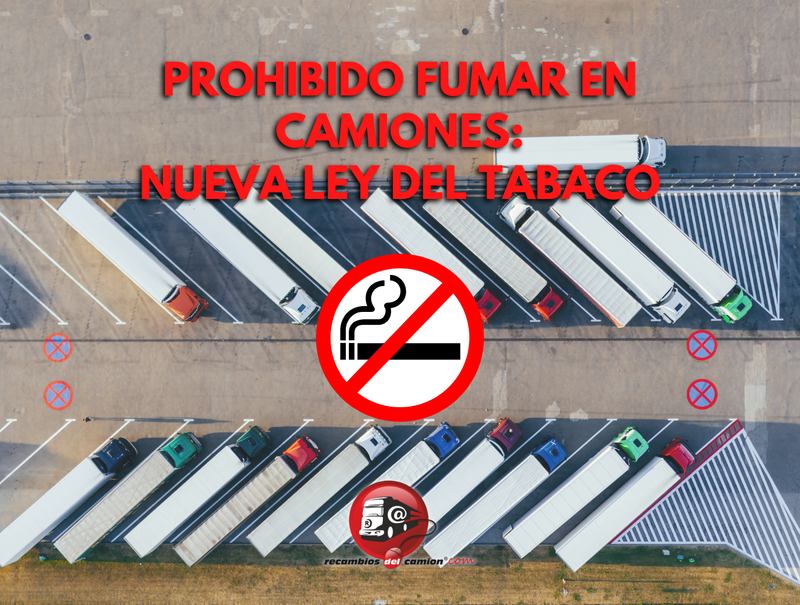
The ban on smoking in professional trucks and vans affects both salaried and self-employed drivers and will apply even when the driver is alone in the vehicle. This measure has been identified as one of the most controversial in the draft law.
In the transport sector, associations such as CETM and Fenadismer already expressed their opposition when the draft law was released. They consider the measure "disproportionate," since most professional drivers spend long hours alone in their cabs, so third parties would not be exposed to tobacco smoke.
Furthermore, some organizations go further, describing this ban as detrimental to road safety, considering that it can generate stress and anxiety in smoking drivers. According to current regulations on driving and rest times, professionals can be behind the wheel for up to four and a half hours at a time, which increases the impact of this restriction. Preventing smoking during this time, they point out, can affect the driver's emotional state and even alter their ability to concentrate behind the wheel.
The reform is not limited to the professional transport environment. The draft bill also includes a significant expansion of smoke-free spaces, both indoors and outdoors. Smoking or vaping will be prohibited in the following places:
- Bar and restaurant terraces
- Public swimming pools
- Bus stops, shelters, and waiting areas
- University campuses and school playgrounds
- Sports facilities and entertainment venues
- Work-use vehicles (including trucks and vans)
Another of the most significant changes is the equating of new nicotine-derived products with traditional tobacco. This includes:
- Electronic cigarettes, with or without nicotine
- Heated tobacco devices
- Smokeless nicotine pouches
- Herbal products for smoking or vaporizing
For the first time, the consumption of tobacco or related products by minors is also prohibited, a measure that until now only applied to sales. In addition, the implementation of plain packaging, which was intended to eliminate visual markings on the packs, has finally been ruled out.
Regarding the sanctioning regime, new infractions have been established and the financial penalties have been updated. Fines for non-compliance with the regulations can reach 600,000 euros, as explained by the Minister of Health, Mónica García.
The new Tobacco Law represents an important step in updating Spanish public health legislation, adapting it to new consumer habits and strengthening restrictions on tobacco and its derivatives. However, its application in the professional transport sector—particularly the ban on smoking in trucks, even when the driver is traveling alone—has generated considerable controversy.
While the draft bill begins its parliamentary process, the debate is ongoing. Industry organizations have already raised their concerns, and it remains to be seen whether any modifications will be introduced that take into account the specific characteristics of professional drivers.
For now, what is certain is that transporters must prepare for possible changes that could directly impact their daily routines and the conditions inside the cabin. We will be closely monitoring how this regulation evolves in the coming months.
Other related articles
 Aug. 24, 2026
AI-powered cameras in Catalonia: Distraction controls on the A-2 and AP-7
For a professional driver, maintaining their license points and avoiding penalties is … Aug. 5, 2026
Solar eclipse 2026: traffic restrictions update
Traffic restrictions planned for the total solar eclipse on August 12, 2026, … July 22, 2026
2026 Solar Eclipse: Traffic Restrictions and Special Measures
The total solar eclipse of August 12, 2026, will be one of … July 10, 2026
Will breathalyzers be mandatory in 2026? Which vehicles are required to have them?
In recent days, numerous news reports have claimed that, from July 7, … June 15, 2026
Opinions of our clients
Receive our news