History of Volvo I trucks (1924-1929)
We begin today the summary of the interesting history of the Volvo brand, focusing on its section dedicated to trucks. In this and in the following articles we will explain a story that begins in 1924 in Stockholm (Sweden), with the dream of an engineer and an economist to create a vehicle designed for the extreme temperatures of the Nordic climate.
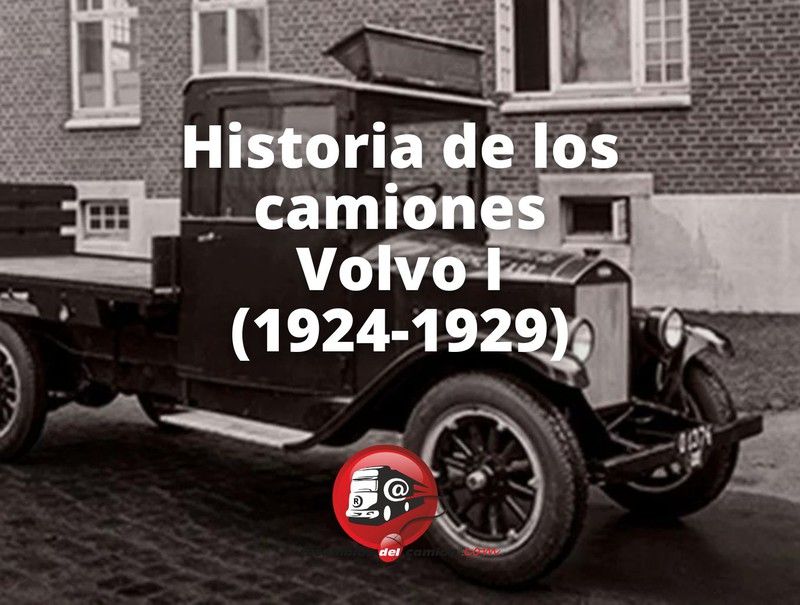
Volvo was founded in 1924 by engineer Assar Gabrielsson and economist Gustaff Larson. The two met in Stockholm to create a car factory, with the financial support of the bearing manufacturer SKF. The brand finally established its headquarters in Gothenburg, as a subsidiary of SKF.
The name chosen for the new brand was VOLVO, which in Latin means "I roll", taking advantage of a trademark that SKF had registered for a new range of its products that was not used. The logo comes from the symbol used by alchemy for iron.
During 1925 the firm's first car was designed, which arrived on the Swedish market in 1927, the Volvo 1 series or ÖV4. This first model marked the foundations of the brand, which opted for resistant vehicles with a robust construction.
The story goes that in the early years of the brand, an ÖV4 had an accident with an imported vehicle, causing major damage to this foreign model and hardly a scratch for the Swedish car.
With the arrival of the 1 Series, the brand also began the process to produce trucks, with high demand at that time in Sweden. Volvo takes advantage of the chassis and engine of its first vehicle to launch its first truck, the Volvo Trucks Series 1, which went on the market in 1928.
Although, as can be seen, the brand was not characterized by great creativity when naming its models, it did incorporate new technologies and innovate in driver comfort. It introduced cardan drives and tires, when, back then, most trucks used chain drives and solid wheels. It also offered the possibility of covering the driver's seat with a cabin, as an option, unlike the rest of the competitors that had open-air wooden seats. The cabin was made by an independent manufacturer, Atvidaberg. This innovation, which seems natural given the cold climate of the brand's home country, was what set Volvo apart from other competitors, who imported their trucks into Sweden. It also included a primitive heating, although innovative for the time, which took advantage of the heat from the engine to heat the air that entered the cabin through the plate that separated the driver from the engine.
It had a 4-cylinder engine with a power of 28 CV and used gasoline as fuel. It allowed maximum speeds of 50 km/h to be reached, although it depended a lot on the load it carried and the characteristics of the terrain.
The 1 Series also featured an innovative three-speed gearbox, of its own design, with gears shorter than those of the brand's cars. It had a payload of 1.5 tons. Although many of its users, at a time when safety was not very relevant and legislation non-existent or very tolerant, claimed that it was capable of carrying up to 3 tons.
The 1-series truck was a complete success, given its design designed for the low Swedish temperatures, being more sold than the 1-series car. In the first six months, 500 units were sold, exceeding all the expectations of the brand, which expected that sales figure after two years from its launch. This success forced the brand to produce 500 more units, without incorporating major innovations, surpassed by the great demand and interest that its first truck had achieved. It kept the same engine and its power, but reduced the number of axles. In addition, it eliminated the slowest gear, significantly reducing the top speed, but achieving significant improvements in the handling of the truck.
The already successful brand did not stop here, working on innovations that responded to some problems with the original design, such as the axle width, which was then the same as that of the cars. The birth of the Volvo 2 Series was being prepared.
Keep learning about Volvo's history in the following article: History of Volvo II trucks (1929-1933)
Other related articles
 Aug. 24, 2026
AI-powered cameras in Catalonia: Distraction controls on the A-2 and AP-7
For a professional driver, maintaining their license points and avoiding penalties is … Aug. 5, 2026
Solar eclipse 2026: traffic restrictions update
Traffic restrictions planned for the total solar eclipse on August 12, 2026, … July 22, 2026
2026 Solar Eclipse: Traffic Restrictions and Special Measures
The total solar eclipse of August 12, 2026, will be one of … July 10, 2026
Will breathalyzers be mandatory in 2026? Which vehicles are required to have them?
In recent days, numerous news reports have claimed that, from July 7, … June 15, 2026
Opinions of our clients
Receive our news