Barreiros, the story of a legendary brand - Part III: decline, legacy, and the end of an era
After a decade of rapid expansion, constant innovation, and consolidation as an industrial leader, Barreiros found itself in a privileged position within the Spanish automotive sector by the end of the 1960s. However, the tide was beginning to change.
In this third and final installment of our series, we address the company's most complex period: Chrysler's gradual entry into its shareholding, management changes, internal tensions, and, finally, Eduardo Barreiros' departure from his own company. We'll see how these transformations profoundly affected the brand's identity and led, in just a few years, to its demise as an independent project.
But we'll also talk about what remained: Barreiros' industrial, technical, and human legacy, which still excites automotive enthusiasts and professionals today. A story that, although it came to an abrupt end, lives on in the memories of many people.
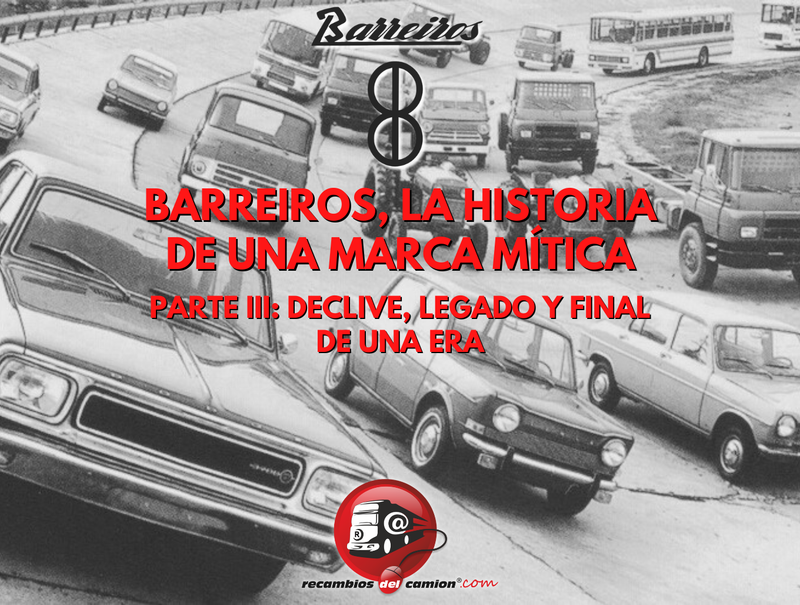
Chrysler's gradual acquisition of shares
In the mid-1960s, Barreiros's strength in the automotive sector did not go unnoticed internationally. The American multinational Chrysler Corporation, with ambitions to expand in Europe, found in Barreiros Diésel S.A. the ideal partner to enter the Spanish market, which was highly regulated at the time and difficult for foreign companies to access.
In 1963, Chrysler began its participation by acquiring 25% of the company's capital. This entry was received with a certain enthusiasm, as it promised financial resources, access to advanced technology, and internationally established models. In the following years, Chrysler increased its shareholding until it gained majority control in 1969, at which point Eduardo Barreiros was forced to step down as CEO.
Changes in Management and Decision-Making
Chrysler's gradual takeover radically transformed the company's internal operations. Management, which until then had been agile, flexible, and under the strong personal leadership of Eduardo Barreiros, was now subordinate to decisions made in the United States. This meant a profound change in the hierarchical structure, with more bureaucracy and less room for local teams to act.
Strategic decisions began to be guided by the logic of the Chrysler group, prioritizing the implementation of its models and standards over the specificities of the Spanish market. New vehicles were introduced under an American license, such as the Dodge Dart, and production processes were adapted to international models. However, this orientation also generated friction, as many decisions did not always align with the real needs of the Spanish consumer or with the company's historical strengths.
Impact on the corporate culture and business model
The innovative and entrepreneurial spirit that had defined Eduardo Barreiros's time gave way to a more corporate culture, dependent on the guidelines of the American parent company. Some of the connection with the local market and with the network of national collaborators and suppliers that had contributed so much to its initial success was lost.
Furthermore, the business model moved away from its own industrial focus (with its own development of engines and vehicles) to become a subsidiary for the assembly and marketing of Chrysler products. This change eroded Barreiros' identity as a benchmark in the Spanish automotive industry and marked the beginning of a slow process of losing relevance.
Clash between Eduardo Barreiros' approach and the American vision
The collaboration between Barreiros and Chrysler, which was initially presented as a mutually beneficial strategic alliance, soon began to show its cracks. Eduardo Barreiros' business model, based on autonomy, practical innovation, adaptation to the local market, and a deep understanding of the Spanish economic environment, clashed head-on with the rigid structure and centralized decision-making of the American giant.
While Barreiros opted for efficient solutions adapted to the national industry, Chrysler sought to replicate its international model, imposing production, design, and management standards that did not always fit the needs of the Spanish customer or the economic context of the time.
Financial difficulties, internal tensions, and strategic disagreements
The progressive integration of Chrysler into the company's shareholding led to a loss of control by Eduardo Barreiros over the company's strategic direction. Decisions began to be made from Detroit, with little sensitivity to the complexity of the Spanish market.
At the same time, financial difficulties began to emerge. The company faced high costs, competition was growing, and new Chrysler models were not always well received. Added to this were internal tensions between executives on both sides of the Atlantic, and the imposition of a new corporate culture that did not fit with the company's original philosophy.
Eduardo Barreiros leaves the company
In 1969, Eduardo Barreiros, disillusioned with the direction the company he had founded was taking, decided to leave the company for good. He did so after losing all real decision-making power and faced with the evidence that the American vision had completely prevailed over his model.
His departure marked the end of an era. The company, which would still bear Barreiros' name for a time, no longer retained its founding spirit. With him, one of the great figures of the 20th-century Spanish automotive industry passed away, a self-made man whose vision revolutionized transportation and engine production in the country.
Loss of Spanish identity
After Eduardo Barreiros' final departure in 1969, the company entered a new era completely dominated by Chrysler Corporation. Although the name "Barreiros" was retained for a time, the brand was no longer essentially Spanish. Strategic, design, and production decisions began to be made in the United States, with little involvement from the local team.
This resulted in a progressive loss of identity. The company that had been born from adapting to the Spanish industrial and social context became just another branch of the Chrysler empire, far from the values of innovation, flexibility, and proximity to the market that had characterized the previous era.
Evolution of the product range
With the new approach, Chrysler reoriented production to adapt it to its global standards. The product range was transformed: models such as the Dodge Dart were introduced, vehicles more focused on the international market, which, although well received by some sectors, did not fully connect with the needs of the Spanish consumer of the time.
The line of industrial vehicles also underwent changes. Although some trucks and vans from the Barreiros era were maintained for a time, they were gradually replaced by Chrysler designs and components, losing the uniqueness that had set Barreiros Diesel apart.
Chrysler's global financial problems and their effect on Spain
In the mid-1970s, Chrysler began to face serious economic difficulties globally. The 1973 oil crisis, growing international competition, and the lack of adaptation to new markets put the American company in check. Losses multiplied, and drastic restructuring decisions were made.
This turbulence also impacted its subsidiary in Spain. Barreiros, now fully integrated into the Chrysler Group, suffered cutbacks, a lack of investment, and growing uncertainty about its future. The company, once a driving force of innovation in the country, was now dragged down by its parent company's financial problems, with no room for maneuver or local support.
The end was approaching, and Barreiros's industrial dream was fading amid corporate decisions made thousands of miles away.
Loss of Spanish identity
Following the departure of Eduardo Barreiros and the complete acquisition of the company by Chrysler, the company entered a new phase marked by the progressive loss of its Spanish identity. The Barreiros brand became completely subordinate to the decisions of the American group, and management began to follow international guidelines with little local autonomy.
The personal, flexible, and domestic-market-friendly approach that had characterized Barreiros Diesel was replaced by a more bureaucratic structure, aligned with Chrysler's global strategy. The Barreiros brand continued to be used as a commercial symbol for a time, but gradually faded away, becoming a mere vestige of its founder.
Evolution of the product range
During this period, the product range also underwent a transformation. Chrysler introduced its own models, such as the Dodge and Simca, manufactured under license at the Villaverde plant. Although some of these vehicles achieved a degree of commercial success, the disconnection with the real needs of the Spanish market was evident in several launches.
Truck production, which had been the original core of Barreiros' business, was gradually giving way to passenger cars. This new focus was not always well received, as Spanish consumers did not find in these new products the same reliability, economy, and robustness as in the vehicles designed by Barreiros' team in the beginning.
Chrysler's global financial problems and their effect on Spain
Meanwhile, Chrysler was beginning to experience serious financial problems internationally, especially in the United States. The oil crisis, Japanese competition, and high production costs severely affected the company, which decided to reduce its presence in markets considered secondary. This situation had a direct impact on Spain, where the subsidiary stopped receiving investment and strategic support. Chrysler Spain's viability began to be jeopardized, and rumors of a sale became increasingly insistent. Finally, in 1978, Chrysler was forced to sell its Spanish subsidiary to the French group PSA Peugeot-Citroën, which integrated the Villaverde factory into its production structure. With this, Barreiros's time under Chrysler's control came to an end, definitively closing a chapter in the history of the Spanish automotive industry.
Cultural, technical and industrial impact
Although the Barreiros brand as such disappeared from the automotive scene, its legacy remains very present in the industrial history of Spain. Eduardo Barreiros was not only an exceptional entrepreneur, but also a key figure in the motorization of the country, driving the development of transport, logistics and mobility in a Spain still anchored in the technological backwardness of the post-war period.
On a technical level, the company left its mark due to its capacity for innovation in the design of diesel engines, the national production of robust and reliable trucks, and for having successfully stood up to much better-positioned foreign brands. Its industrial model, based on efficiency, local production, and adaptation to the environment, served as inspiration for later generations of engineers and businessmen.
Barreiros also had a cultural and symbolic impact: it became synonymous with progress, effort, and modernization, at a time when Spain was struggling to regain its industrial pulse after decades of isolation.
Restorations, clubs, and current enthusiasts
Decades after the brand's disappearance, the name Barreiros continues to generate admiration and respect among collectors and classic car enthusiasts. Clubs of Barreiros friends, forums, historic vehicle events, and gatherings dedicated exclusively to models manufactured by the brand have been created.
Many of these vehicles, including trucks, passenger cars, and tractors, have been carefully restored and preserved and continue to serve as tangible evidence of a golden age of Spanish industry. Thanks to the passion of these enthusiasts, Barreiros's story has not been forgotten.
Posthumous recognition of Eduardo Barreiros
Eduardo Barreiros has been recognized institutionally and publicly with numerous tributes, both during his lifetime and after his death in 1992. Among the most notable is the creation of the Eduardo Barreiros Foundation, whose objective is to preserve and disseminate his business, technical, and human legacy.
Furthermore, his biography has been the subject of books, documentaries, and academic studies that highlight his role as one of the most important industrialists of the 20th century in Spain. Today, Barreiros is remembered not only as a great businessman, but also as a visionary who championed modernization and self-sufficiency at a key moment for the country.
The story of Barreiros is that of a company that was born from the ingenuity and determination of one man, grew to become a symbol of Spanish industrial development, and ended up absorbed by the dynamics of globalization and the interests of large corporations. Despite his corporate demise, the legacy of Eduardo Barreiros and his brand lives on in the collective memory, in restoration workshops, and on the roads where some of his vehicles still occasionally circulate.
Barreiros didn't just manufacture trucks and engines: he built an important part of the industrial and emotional fabric of a country in transformation. Its story is a reminder of what can be achieved with vision, hard work, and commitment, but also of the challenges of remaining true to one's own model in an increasingly interconnected world.
We encourage you to continue exploring more stories of the Spanish motor industry and discover other brands and personalities that defined an era.
Other related articles
 Aug. 24, 2026
AI-powered cameras in Catalonia: Distraction controls on the A-2 and AP-7
For a professional driver, maintaining their license points and avoiding penalties is … Aug. 5, 2026
Solar eclipse 2026: traffic restrictions update
Traffic restrictions planned for the total solar eclipse on August 12, 2026, … July 22, 2026
2026 Solar Eclipse: Traffic Restrictions and Special Measures
The total solar eclipse of August 12, 2026, will be one of … July 10, 2026
Will breathalyzers be mandatory in 2026? Which vehicles are required to have them?
In recent days, numerous news reports have claimed that, from July 7, … June 15, 2026
Opinions of our clients
Receive our news