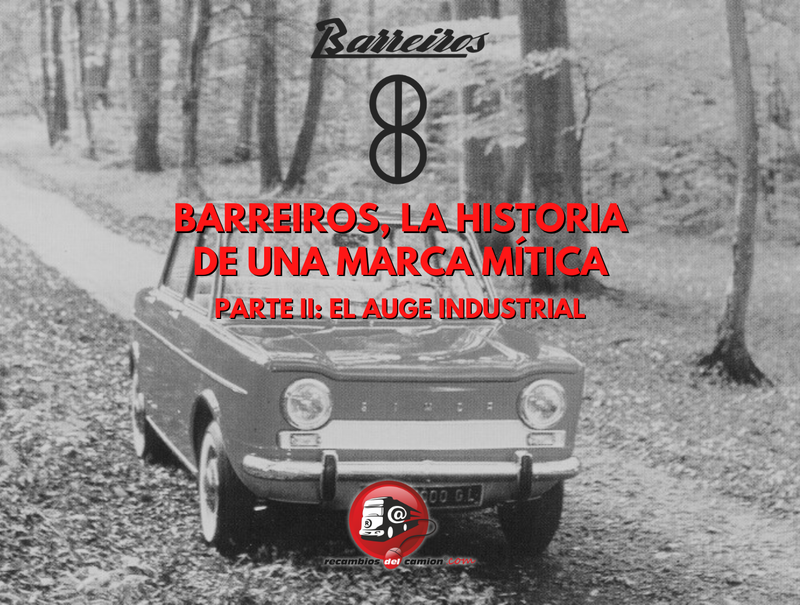
Barreiros, the story of a legendary brand - Part II: the industrial boom
After laying the foundations of his empire with the founding of Barreiros Diésel, S.A., Eduardo Barreiros embarked on an ambitious period of expansion and consolidation. With an advanced industrial vision and a practical and efficient approach, Barreiros knew how to take advantage of the needs of the Spanish market in the 1950s and 1960s, modernizing transportation and paving the way for a new generation of vehicles manufactured in Spain.
In this second chapter, we review how the company consolidated itself as one of the country's leading industrial leaders, how it diversified its production, and how the collaboration with international brands that would shape the company's future emerged.
After the founding of Barreiros Diésel, S.A., the company experienced dramatic growth in just a few years. Eduardo Barreiros' ingenuity and drive were not limited to the design and transformation of engines, but translated into a clear business vision: to build a solid and modern industrial infrastructure capable of mass-producing vehicles with high quality standards.
The Villaverde plant, inaugurated in the mid-1950s in the south of Madrid, was the epicenter of this industrial revolution. Conceived as one of the most advanced facilities of its time in Spain, it not only produced engines but also integrated all the processes necessary to manufacture trucks, buses, and later, passenger cars. This factory represented Barreiros' dream: a national industry capable of competing in quality and volume with major European manufacturers.
During the country's development period, the Villaverde factory came to employ more than 5,000 workers, including operators, technicians, and engineers. The environment there was dynamic, one of constant learning and improvement, with a young and committed workforce that grew alongside the brand itself.
Vehicle production grew year after year, with particular success in the heavy and medium truck segment, which quickly gained a foothold among transporters and companies throughout Spain. Barreiros engines, renowned for their reliability and low fuel consumption, helped to forge a solid reputation that would be maintained throughout the following decade.
This period marked the beginning of Barreiros' true rise, not only as a vehicle manufacturer but also as a symbol of the economic and technical changes the country was experiencing during the Franco era.
One of the keys to Barreiros' growth was its ability to rapidly diversify its production. While its first successes came with its converted diesel engines, the company quickly expanded its catalog to cover other needs of the Spanish market, which was undergoing a period of industrial and social transformation.
From engines to complete vehicles
At first, Barreiros only manufactured diesel engines that were fitted to existing vehicles, such as converted buses or gasoline trucks. However, the logical step was to build its own complete vehicles, which allowed for greater control over quality, costs, and design. Thus, in 1958, the first Barreiros complete truck was launched: the Azor.
This robust and highly reliable model was the first in a series of trucks that would become a landmark. Its arrival marked a key step in the transformation of heavy transport in Spain, and it would soon be joined by other models such as the Saeta, the Super Azor, and the Condor, increasingly more powerful and adapted to the needs of national transport.
Entry into the world of passenger transport
Success in freight transport led Barreiros to also explore the passenger transport market. It manufactured its own buses and coaches, such as the Barreiros 4000 and the Barreiros 5000, highly valued for their reliability and low fuel consumption. These vehicles began to form part of the urban landscape and regional transport fleets in many parts of Spain.
Light commercial vehicles and tractors
In addition to heavy trucks, the company also opted for lighter vehicles such as vans, pickup trucks, and agricultural tractors. In this way, Barreiros expanded its market and strengthened its presence in the rural and industrial sectors, which were essential in post-war Spain.
A brand that covered the entire spectrum
In just a few years, Barreiros managed to become a true symbol of national industry. Its product range included everything from engines and tractors to trucks, vans, buses, and coaches. All of this without losing its hallmark: the efficiency of the diesel engine, its practical design, and its ability to adapt to the country's needs.
In the mid-1960s, Barreiros' accelerated growth was beginning to require more capital and access to international technology in order to compete with major European manufacturers. In this context, a strategic alliance emerged that would mark a turning point in the company's history: the entry of the American giant Chrysler into Barreiros' shareholding.
A need for expansion and stability
Eduardo Barreiros' objective was ambitious: to consolidate the company as an international benchmark while maintaining its independence. However, the significant investment required to move into passenger car production and the expansion of the production infrastructure—especially the Villaverde factory—required the company to seek partners with financial strength and experience in the sector.
In 1963, Barreiros signed an agreement with Chrysler Corporation, which initially acquired 35% of the company's capital. This gave Barreiros access to new technologies, manufacturing licenses, and international distribution channels. Within a few years, Chrysler would increase its stake to over 70%, allowing it to take control of the company in 1969.
Passenger car production: the Dodge made in Spain
Thanks to this collaboration, Barreiros began the licensed manufacture of several Dodge and Simca models. One of the most iconic was the Dodge Dart, a large and elegant car that represented a commitment to offering the Spanish market a high-end passenger car manufactured locally. Other models were also produced, such as the Simca 1000 and the Dodge 3700 GT, which marked an era.
Although entry into the passenger car market was not easy—partly due to the competition and the unusual size of the car for the average Spanish consumer at the time—it served to modernize the brand's image and open up new business avenues.
Tensions between business philosophy
Chrysler's entry brought with it a much more hierarchical way of managing the company, far removed from the family-based and innovative model that had characterized Eduardo Barreiros. This difference in approach generated internal tensions. While Barreiros prioritized ingenuity, autonomy, and adaptation to the Spanish market, the American multinational imposed its corporate logic and international standards.
Finally, in 1969, Eduardo Barreiros left the management of the company that bore his name. The company was renamed Chrysler Spain, bringing to an end a golden age in which a Spanish brand had managed to compete head-to-head with the industry's biggest names.
During the second half of the 1960s, the Barreiros company experienced unprecedented industrial growth in the Spanish automotive sector. The alliance with Chrysler, although controversial internally, provided the necessary economic and technical resources for Barreiros to expand both in production capacity and in foreign markets.
The Villaverde factory: a symbol of modernization
One of the most notable achievements was the expansion and consolidation of the Villaverde factory (Madrid), which became one of the most advanced industrial complexes in Europe at the time. It manufactured everything from engines to complete vehicles, with a degree of vertical integration that was very unusual at the time.
Villaverde represented Eduardo Barreiros' dream: a strong, modern national industry capable of competing in quality and volume with the major automotive powers. Although with Chrysler in charge, many of these decisions were no longer under its control, its industrial legacy remained.
Exports and new markets
The industrial strength allowed Barreiros vehicles—both trucks and passenger cars—to begin to be exported to other countries. Africa, Latin America, and some European markets received vehicles manufactured in Spain, a demonstration of the reach the brand had achieved in just a decade.
In the field of industrial vehicles, Barreiros trucks were especially valued for their durability, adaptability, and value for money, characteristics that made them ideal for countries with extreme climates or precarious infrastructure.
A benchmark at international fairs
Barreiros also played a leading role at important international automotive fairs and exhibitions, such as the Barcelona International Motor Show or the Paris International Motor Show, where its presence represented not only the brand but the entire Spanish industry. Its modern image and commitment to technological innovation helped project a new image of Spain abroad, far removed from the industrial backwardness of previous decades.
One of the keys to Barreiros' growth and consolidation as an industrial leader was its determined commitment to product diversification. The company wasn't content with producing engines or trucks: it expanded its horizons to other automotive sectors, such as agricultural tractors, buses, and, especially, passenger cars.
Trucks: the heart of the brand
From the beginning, Barreiros trucks were synonymous with reliability. With robust models designed to withstand the harsh conditions of road transport in Spain and other countries, the brand managed to position itself as a favorite in the sector. Vehicles such as the Barreiros Saeta, the Super Azor, and the 42/20 became common sights on the country's roads and logistics points.
Transporters valued their durability, affordable maintenance, and power. Furthermore, Barreiros knew how to adapt its vehicles to different loads and needs, creating versions for construction sites, urban transport, and even military use.
Tractors: Technology for the Countryside
Aware of the importance of the agricultural sector in the Spanish economy, Barreiros also focused on the design and manufacture of diesel tractors. Taking advantage of its knowledge of engines, it developed a range adapted to the needs of the Spanish countryside, characterized by its low consumption, ease of use, and durability.
This foray further reinforced Barreiros' image as a brand committed to the country's progress, not only in terms of mobility, but also with regard to rural development.
Buses and Special Vehicles
Barreiros also produced buses and minibuses, intended for both urban and intercity transport. Although their production volume was lower than that of trucks, these vehicles helped complete the company's mobility offering, consolidating its profile as a comprehensive manufacturer.
The leap into passenger cars: the "Spanish Dodge"
The alliance with Chrysler allowed Barreiros to enter the personal car market, a significant leap that placed the company on new competitive terrain. Models such as the Dodge Dart Barreiros, produced in Spain under license, symbolized this new era.
Although the passenger car sector presented greater challenges—due to competition from European brands and the low motorization of the population at the time—Barreiros' entry into this segment was a milestone for the national industry, demonstrating that it was possible to manufacture high-end vehicles in Spain.
Throughout the 1960s, Barreiros not only established itself as an automotive giant in Spain, but its name also began to resonate widely beyond our borders. Eduardo Barreiros' combination of technical innovation, productive capacity, and entrepreneurial vision led the brand to occupy a prominent place both in the industrial sphere and in the country's collective imagination.
A benchmark in Spanish industry
In an era marked by technological limitations, economic isolation, and a lack of foreign investment, Barreiros symbolized the possibility of a modern and competitive national industry. His factories employed thousands of workers, revitalized auxiliary sectors, and placed Spain on the European automotive map. The integrated company model he designed, capable of manufacturing everything from engines to complete vehicles, was unusual in post-war Spain.
Barreiros' social impact was equally notable. In a country still dominated by an agricultural economy, the image of Barreiros trucks transporting goods across the country became an icon of progress. Many transporters began their professional careers thanks to these vehicles, which offered an economical, reliable, and national solution.
International Recognition
Barreiros' success did not go unnoticed abroad. Its agreement with Chrysler not only represented an influx of capital and technology, but also explicit recognition from a major multinational for the quality of its work. The licensed production of vehicles like the Dodge Dart demonstrated that Spain could manufacture vehicles to international standards.
Furthermore, its diesel engines began to be exported and used in other countries, consolidating Barreiros' presence beyond our borders. Even in Latin America and some African countries, its vehicles began to be seen as a reliable alternative to traditional European brands.
A legacy that lives on
Although the brand itself disappeared in the 1970s after being taken over by Chrysler, Barreiros' legacy lives on. In museums, private collections, classic car associations, and, above all, in the memories of those who lived through its golden age, the name Barreiros continues to inspire admiration.
Initiatives such as the Eduardo Barreiros Foundation have helped preserve its history and vindicate its role in Spain's industrial development. His figure has been the subject of documentaries, books, and tributes, and his impact continues to be a subject of study for those who analyze the history of the company and innovation in our country.
Barreiros not only established itself as a benchmark brand in the Spanish automotive industry, but also demonstrated that with vision, effort, and the ability to adapt, the limits of the economic and political context of the time could be overcome. The alliance with international brands and the expansion of its range were key steps in its expansion.
But Barreiros' path was not without challenges. In the next installment, we will address the brand's most complex period: the entry of Chrysler, the structural changes, and the subsequent decline of one of the most exciting industrial adventures in recent Spanish history.
Other related articles
 Aug. 24, 2026
AI-powered cameras in Catalonia: Distraction controls on the A-2 and AP-7
For a professional driver, maintaining their license points and avoiding penalties is … Aug. 5, 2026
Solar eclipse 2026: traffic restrictions update
Traffic restrictions planned for the total solar eclipse on August 12, 2026, … July 22, 2026
2026 Solar Eclipse: Traffic Restrictions and Special Measures
The total solar eclipse of August 12, 2026, will be one of … July 10, 2026
Will breathalyzers be mandatory in 2026? Which vehicles are required to have them?
In recent days, numerous news reports have claimed that, from July 7, … June 15, 2026
Opinions of our clients
Receive our news