Barreiros, the story of a legendary brand - Part I: the origins of a Spanish motor legend
To speak of Barreiros is to speak of one of the greatest figures in the automotive industry in recent Spanish history. Long before producing recognizable trucks and establishing alliances with international brands, Barreiros was, above all, the dream of a Galician entrepreneur with a unique intuition for detecting opportunities in a country marked by post-war restrictions.
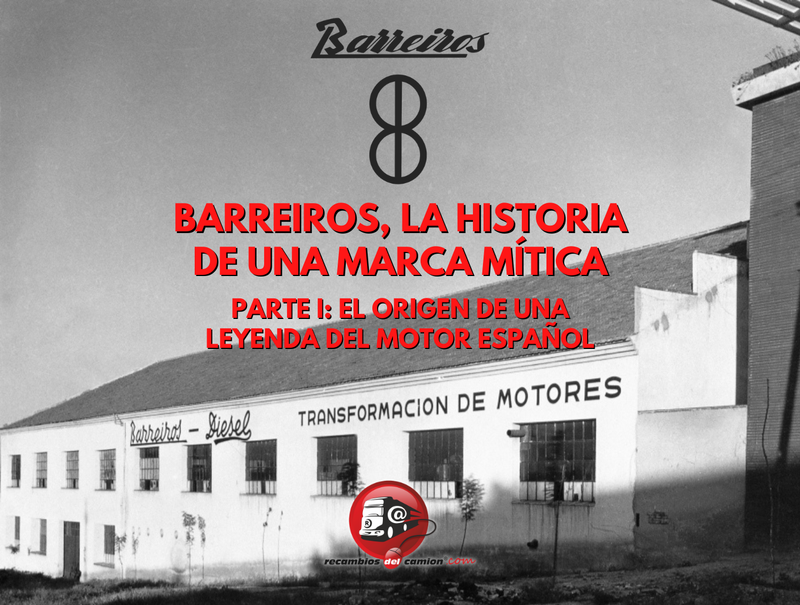
Barreiros's story begins long before he founded a factory or developed an engine. It began in the bosom of a humble Galician family, with a boy who grew up among tools, grease, and engines. Eduardo Barreiros was born in Gundiás (Ourense) in 1919, at a time when Spain was mostly rural and transportation was still a luxury.
His father, Herminio Barreiros, was one of the first bus drivers in the province. He wasn't just any driver: Herminio was also the owner and mechanic of his vehicles, and offered a regular transport service between Ourense and the Ribeiro region. In those days, buses were more like adapted trucks, and driving them required skill, patience, and, above all, knowing how to constantly repair them.
Growing up among tires, tools, and the comings and goings of travelers, Eduardo absorbed the workings of engines and the routines of road transport from childhood. His father taught him to drive when he was just a teenager, and also instilled in him the value of a job well done, ingenuity to get ahead with limited resources, and commitment to the customer.
Although he didn't formally study engineering, Eduardo had a brilliant technical mind. From a very young age, he became interested in mechanics and began helping his father with repairs. That early experience was, without a doubt, his best learning experience. He soon became a key figure in the small family workshop and quickly showed an innate ability to understand how engines worked.
At just 20 years old, he was already assembling and disassembling engines on his own, and during the post-war period, he saw what others didn't: that gasoline was expensive and difficult to obtain, and that converting vehicles to diesel could change the lives of many transporters like his father. This is how his idea of "dieselizing" engines was born, a practical, inexpensive solution adapted to the context of Spain at the time.
This vision, inherited from his father's entrepreneurial and decisive spirit, was the seed of what would later become Barreiros Diésel S.A., one of the most important industries in the history of the Spanish automotive industry.
After years of experience in the automotive world, first as a mechanic and later as an innovative converter of gasoline to diesel engines, Eduardo Barreiros took the final step into industry. In 1954, he founded Barreiros Diésel, S.A. with his father and brothers, based in a small workshop in Ordes (A Coruña). What began as a family business quickly became a national benchmark.
The initial idea was simple, but revolutionary for its time: adapt gasoline engines, especially those from the post-war vehicle fleet, to run on diesel, a much cheaper and more efficient fuel. In a Spain still impoverished and resource-scarce, this conversion offered a huge economic advantage to transporters and companies. The first adapted models, such as the Barreiros EB-6 engines, proved to be robust, efficient, and perfect for trucks, tractors, and buses.
Success was immediate. The demand for transformations and engines grew so much that Eduardo Barreiros decided to expand. In just a few years, his modest workshop became a large-scale factory located in Villaverde (Madrid), with more than 100,000 square meters and equipped with the most modern technology of the time. There he began manufacturing his own engines, trucks, tractors, and even military vehicles.
In addition to his technical talent, Barreiros demonstrated great skill as an entrepreneur. He attracted engineers, invested in machinery, sought alliances, and invested in training. He didn't just build vehicles: he built an industry, betting on his own, competitive, and 100% Spanish automotive industry in an era dominated by foreign brands.
At the same time, the company diversified its production. By the mid-1950s and early 1960s, they were already manufacturing trucks, tractors, and industrial engines under the Barreiros brand, positioning themselves as one of the pillars of Spanish economic development in the midst of the Franco dictatorship.
The birth of Barreiros Diesel was more than the founding of a brand: it was the beginning of an industrial and technological revolution in Spain. A dream come true for a self-taught Galician who saw diesel as the engine of the future.
The history of Barreiros cannot be explained solely by production figures or truck models. Its true driving force was a unique business philosophy, marked by three fundamental pillars: constant innovation, a culture of hard work, and an astonishing ability to adapt to the circumstances of the country and the market.
From the very beginning, Eduardo Barreiros demonstrated that his goal was not simply to manufacture vehicles, but to create solutions. Unlike other entrepreneurs of the time, his obsession was not to import technology, but to develop and perfect it locally. Therefore, from the very beginning, he committed to research, to surrounding himself with trained technicians, and to incorporating pioneering manufacturing processes in Spain. His workshop in Ordes was transformed into a true factory of ideas.
Barreiros also firmly believed in the value of a job well done. In his own words, “with hard work, you can do anything,” and that mentality permeated the entire organization. He trained his staff, encouraged employee involvement, and fostered a spirit of continuous improvement, which was key to scaling the company from a family workshop to one of the country's leading industries in just a decade.
Another essential element was his ability to adapt. In a context of autarky, scarcity of raw materials, and a market controlled by the Franco regime, he knew how to read the historical moment. First, by offering diesel conversions to take advantage of existing vehicles; then, by developing his own engines and vehicles; and later, by diversifying into transportation, agricultural machinery, and even the military sector.
When political pressure and the need for growth led him to seek alliances with international manufacturers in the 1960s, Eduardo Barreiros did not hesitate to adapt once again, closing agreements with brands such as Chrysler, which would mark a new era for his company. Although this shift would bring with it other challenges, it demonstrates the versatility of an entrepreneur who always sought to keep his project alive, even in a difficult context.
Barreiros' philosophy transcended the factory: he was a model of modernity, of ingenuity applied to everyday life, of commitment to his country, and of industrial ambition in a Spain that was barely waking up to industrialization. His legacy lives on not only in his trucks, tractors, and engines, but in his way of understanding business as a tool for social transformation.
After the initial success of converting gasoline engines to diesel—a highly sought-after solution in post-war Spain due to its fuel savings—Eduardo Barreiros and his team realized that their future could not depend exclusively on this business. The growing demand for transportation, the economic development of the 1950s, and the lack of commercial vehicle supply in the domestic market opened up an opportunity that Barreiros was not willing to pass up.
In 1954, Barreiros Diésel, S.A. was founded, a company that not only dedicated itself to engine manufacturing but also had the more ambitious goal of designing and building its own vehicles. It was a natural but courageous step, as it involved a change of scale: moving from the workshop to heavy industry. And, as was typical of Barreiros, it did so by investing in domestic talent, without relying on foreign technologies in its early days.
The brand's first industrial vehicles were its own trucks, robust and functional, designed with the harsh conditions of Spanish roads and the needs of freight transport in mind. One of the first iconic models was the Barreiros TT 90, which stood out for its reliability and for being fitted with one of the company's own diesel engines. They also manufactured agricultural tractors, which were widely accepted in rural areas.
The key to the success of these vehicles was their mechanical simplicity, ease of repair, and low fuel consumption—fundamental elements in a Spain where maintenance often had to be performed by non-professionals. Furthermore, Barreiros knew how to listen to transporters and farmers, adapting its models to everyday demands, something that major international manufacturers were not doing.
In just a few years, Barreiros went from being an engine manufacturer to becoming a national benchmark in industrial vehicles. Its growth was so rapid that by 1959 they already had one of the most modern factories in Europe, in Villaverde (Madrid), with the capacity to produce trucks, buses, tractors, and engines on a large scale.
This leap into truck manufacturing was a turning point: Barreiros was no longer just a name; it was a brand with an identity, with models that traveled the country's roads and were even beginning to attract interest in international markets. The Spanish industry finally had a manufacturer capable of competing with the large multinationals, and this was thanks to a clear and determined vision.
The journey of Eduardo Barreiros and his company had just begun, but it already revealed a history marked by innovation, forward-thinking, and the ability to transform ideas into industry. From engine conversions to the first trucks on Spanish roads, Barreiros established itself as a pillar of the Spanish automotive industry.
👉 In the next article, we'll explore the rise of the Barreiros brand, its international expansion, and the strategic alliances that brought it into contact with the biggest names in the sector. Don't miss it!
Other related articles
 Aug. 24, 2026
AI-powered cameras in Catalonia: Distraction controls on the A-2 and AP-7
For a professional driver, maintaining their license points and avoiding penalties is … Aug. 5, 2026
Solar eclipse 2026: traffic restrictions update
Traffic restrictions planned for the total solar eclipse on August 12, 2026, … July 22, 2026
2026 Solar Eclipse: Traffic Restrictions and Special Measures
The total solar eclipse of August 12, 2026, will be one of … July 10, 2026
Will breathalyzers be mandatory in 2026? Which vehicles are required to have them?
In recent days, numerous news reports have claimed that, from July 7, … June 15, 2026
Opinions of our clients
Receive our news