All about the spare wheel: regulations, alternatives, and tips
A simple puncture can completely ruin your plans. Imagine being in the middle of a trip, on a secondary road or on the highway, and suddenly noticing how your car loses stability. One of the most common but also most stressful situations for any driver is facing a flat tire. In those moments, the key question is: am I prepared for this?
Although Spanish law does not require carrying a spare tire, it does require your vehicle to have a system that allows you to continue your journey in the event of a puncture. This rule, more flexible than many believe, opens the door to various options: traditional wheels, temporary wheels, puncture-proof kits, or run-flat tires. But which is the safest? What are the advantages of each alternative?
In this article, we're going to take an in-depth look at all the available solutions, their legality, their risks, and the most sensible recommendations so that if you're faced with a flat tire, you'll know how to act without endangering your safety or that of other road users.
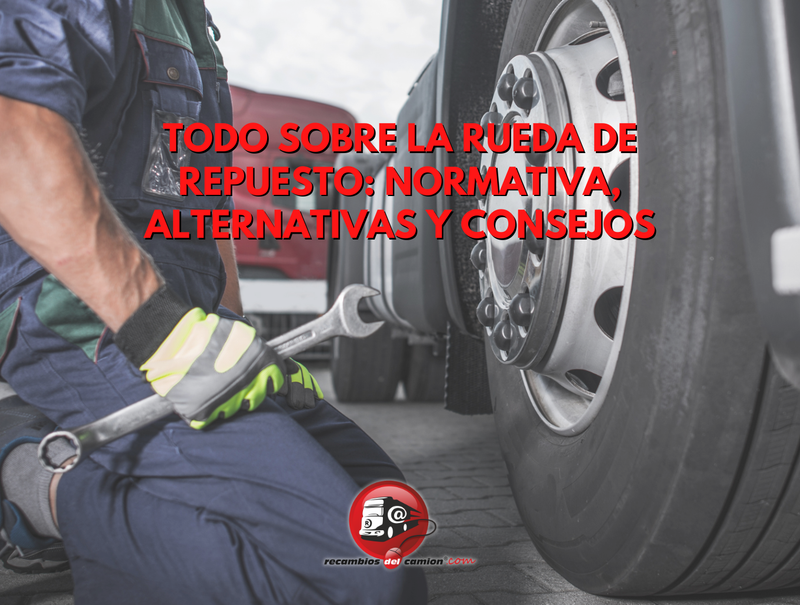
In Spain, there is no specific obligation to carry a traditional spare tire in your car. However, the law does require that the vehicle be ready to continue driving after a tire failure. This is stated in the General Vehicle Regulations (Royal Decree 2822/1998), which establishes that vehicles must be equipped to ensure road safety.
That is, it doesn't matter whether you carry a conventional spare tire, a "cookie-cutter" type tire, a puncture repair kit, or run-flat tires. The important thing is that you can resolve an incident without compromising your safety or that of other road users.
It is increasingly common for new vehicles to leave the dealership without a spare wheel. The main reason is to reduce the car's weight, which directly impacts fuel consumption and pollutant emissions. Instead of the classic spare wheel, many manufacturers include:
- A temporary use wheel (cookie): smaller and lighter, which only allows driving at low speeds and for a limited distance.
- A puncture repair kit: consisting of a sealant and a compressor that allows the hole to be temporarily covered.
- Run-flat tires: which can be driven for a few kilometers after the puncture without needing to be replaced immediately.
This trend has an ecological and efficiency background, but can pose a problem if the driver is not familiar with the limitations of these solutions.
Thanks to advances in tire technology, punctures are less common today than they were a few decades ago. However, they still occur. Statistics indicate that, on average, a puncture occurs every 75,000 kilometers. Although this may seem like a distant figure, it all depends on the type of driving, tire maintenance, and road conditions.
Furthermore, tires account for approximately 30% of road incidents, making them one of the most problematic components of a vehicle.
Below, we analyze the different alternatives with which you can equip your car to be prepared for a puncture:
1. Traditional spare wheel
This is the most complete option. It allows you to replace the damaged tire and continue your trip completely autonomously. Of course, it takes up more space in the trunk and adds weight to the vehicle.
2. Temporary use or cookie wheel
This is much lighter and more compact than a conventional wheel, but it has clear limitations: it can only be driven at low speeds (usually no more than 80 km/h) and for short trips. Its function is to take you to the nearest garage.
3. Puncture repair kit
This consists of a sealing liquid and a compressor to inflate the tire after the temporary repair. It is very easy to use and takes up little space, but it is not suitable for all types of punctures nor does it guarantee a permanent repair.
4. Run-flat tires
They can travel between 50 and 100 km after a puncture without having to go flat. They require specific rims and, although they provide comfort, their cost is high and subsequent repairs are limited.
Puncture repair kits have become extremely popular in recent years. They are compact, easy to use, and allow for temporary repairs without the need for tools or physical effort. But their convenience doesn't always go hand in hand with safety.
One of the main problems with puncture repair kits is that they only seal the puncture from the outside, without allowing for an assessment of any internal damage to the tire. This poses a significant risk: even if the tire can be reinflated and the vehicle continues rolling, there could be hidden damage that weakens its structure and causes a blowout while driving.
The object that caused the puncture could have penetrated deeper or cut the inner casing of the tire. This damage is not visible to the naked eye and, if not properly inspected, could become a serious threat to your safety.
In short, puncture repair kits are good for getting you through a difficult situation, but they are not a permanent or completely safe solution. In fact, many shops can't repair a tire after using these types of kits, forcing you to replace it entirely.
Although it may seem like a hassle, calling a tow truck in the event of a flat tire is, in many cases, the safest and most sensible option. This service, included in most insurance plans, allows a professional to properly assess the condition of the tire and the vehicle, avoiding unnecessary risks.
These are some of the most important advantages of opting for roadside assistance:
- Greater safety: you don't risk driving with a damaged or poorly repaired tire.
- Absolute peace of mind: you avoid having to change the wheel yourself, especially in dangerous conditions such as on motorways or in bad weather.
- Professional repair: the tire is completely removed in the workshop for inspection both inside and out.
- Money savings: if the damage is repairable, a professional can repair the tire without having to change it, something that isn't possible if you've already used a puncture repair kit.
- Less wear and longer warranty: repairs carried out in specialized workshops offer greater durability and confidence.
Another important point that many drivers overlook is the condition of the spare tire itself. While having one is a good thing, it's useless if it's not in proper condition. A tire that hasn't been used for years may have lost pressure, become warped, or be damaged by the passage of time.
Therefore, periodically checking the pressure and condition of the spare tire is just as important as checking the tires you're using. In many garages, this check is free and can save you from a bigger problem in an emergency.
Some garage networks, such as Euromaster, offer services such as MasterGarantía, designed for those who want to drive with complete peace of mind. This optional warranty covers damage that your tires may suffer during their useful life, including punctures, blowouts, loss of tire pressure, or even vandalism.
Some of the coverage included are:
- Free repair of the damaged tire.
- Replacement if it is not repairable, depending on the degree of wear.
- Removal, internal and external inspection, and refitting.
- Nitrogen inflation if necessary.
- Tire balancing.
All of this, carried out by qualified professionals and in specially prepared facilities, guarantees that you not only get back on the road as soon as possible, but also do so in complete safety.
Although a puncture is unexpected, being prepared and keeping your vehicle in good condition greatly reduces the risks. Here are some practical recommendations that can save you trouble:
- Check your tire pressure every two weeks or before each long trip.
- Check the tire tread and wear: the legal limit is 1.6 mm, but ideally, change it sooner.
- If you carry a spare tire, make sure it's properly inflated.
- Find out if your insurance includes roadside assistance from kilometer 0.
- Keep a reflective vest, triangles, or approved V16 lights in the car to signal the breakdown.
It may never have happened to you before, or you may have already experienced it on the road. Whatever your case, the important thing is to be prepared. Carrying the right equipment, knowing the options offered by the regulations, and knowing how to react in the event of a flat tire can save you scares, time, and money.
It's not just about complying with the law; it's also about protecting your safety and that of those around you. Carefully evaluate which system best suits your vehicle and your driving style, and remember that the best solution will always be the one that guarantees a safe and trouble-free trip.
Other related articles
 Aug. 24, 2026
AI-powered cameras in Catalonia: Distraction controls on the A-2 and AP-7
For a professional driver, maintaining their license points and avoiding penalties is … Aug. 5, 2026
Solar eclipse 2026: traffic restrictions update
Traffic restrictions planned for the total solar eclipse on August 12, 2026, … July 22, 2026
2026 Solar Eclipse: Traffic Restrictions and Special Measures
The total solar eclipse of August 12, 2026, will be one of … July 10, 2026
Will breathalyzers be mandatory in 2026? Which vehicles are required to have them?
In recent days, numerous news reports have claimed that, from July 7, … June 15, 2026
Opinions of our clients
Receive our news