14 tips for safe night driving
Driving at night presents unique challenges and can be dangerous if proper precautions are not taken. In Spain, almost 30,000 accidents with victims (29%) were registered during the night, dusk or dawn in 2019. Surprisingly, these accidents represented almost 40% of the deaths in traffic accidents, with 700 people killed. This demonstrates the seriousness of nighttime accidents. In this article, we will provide you with important tips and precautions to make night driving safer and avoid unnecessary risks.
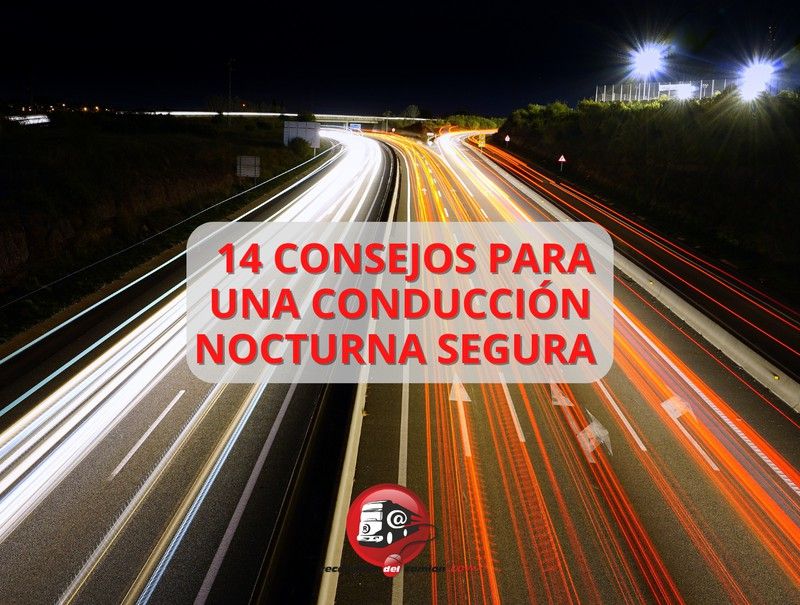
Although the majority of accidents in Spain occur during the day, around 70%, both in urban and interurban areas, it is concerning that accidents that occur at night, dusk or dawn account for a disproportionate percentage of victims . Despite the fact that these accidents only represent 28% of all accidents with victims, they claim almost 40% of lives and have a higher percentage of fatal accidents, 38%. This is alarming considering that the traffic is less intense at night. In 2019, the fatality rate for accidents in Spain was 1.2, while that for nighttime accidents, including dusk and dawn, was 1.69, indicating a 40% increase in the severity of nighttime accidents. .
According to a report by the General Directorate of Traffic (DGT) entitled "The main figures of Road Accidents. Spain 2019", the fatality rate during the night (from 00:00 to 6:59) it almost doubles that of the rest of the day (from 7:00 a.m. to 11:59 p.m.). For example, the general rate during the day is 1.1, while at night it is 2.6. Also, from Monday to Friday, the case fatality rate during the day is 1.0, but increases to 2.8 at night.
Another alarming finding is that the rate of fatal accidents per kilometer quadruples overnight, according to automotive lighting manufacturer Osram. A prestigious Norwegian safety and transport researcher, Rune Elvik, after comparing accidents that occurred during the day and at night in Norway, Sweden and the Netherlands in 2009, found that the risk of an accident with victims increases by almost 30% at night in urban areas, about 50% on interurban roads and about 40% in rural and urban areas combined.
Driving at night presents challenges due to lower visibility. According to Ernesto Nava, director of the Driving School of the Royal Automobile Club of Spain (RACE), "it is more difficult to drive at night due to less visibility." A RACE study entitled "Lighting and Road Safety" highlights that at night, our ability to perceive objects, colors and distances is significantly reduced compared to daytime driving.
Here are some essential tips for safer night driving:
1. Make sure your lights are working: Before you start your night trip, check that all the lights in your vehicle are working properly. Make sure your headlights are clean and properly aligned to provide good illumination of the road. Also make sure your taillights, turn signals, and brake lights are working properly.
2. Use your headlights correctly: At night, turn on your low beams when driving to illuminate the road without dazzling oncoming drivers. Use your high beams only when there is no oncoming traffic, and quickly turn them off if you see another vehicle approaching. Remember that it is mandatory to turn on the dipped or dipped headlights in low visibility conditions, even during the day.
3. Keep windshields and mirrors clean: Glare can be more pronounced at night due to headlights from other vehicles and particles on the windshield. Make sure the windshield is clean and free of marks that could hinder your visibility. Also, adjust your rearview mirrors to minimize glare.
4. Slow down: Driving at high speed at night increases the risks, since you have less time to react to anything unexpected. Reduce speed and maintain an adequate safety distance with the vehicle that precedes you.
5. Pay attention to fatigue: Night driving can be more tiring than daytime driving. If you feel tired, it's important to take a break and rest before continuing to drive. Fatigue negatively affects your reflexes and your ability to stay focused on the road.
6. Avoid distractions: At night, it is even more important to avoid distracted driving. Keep your attention on the road and avoid cell phone use or other activities that divert your attention.
7. Be aware of pedestrians and cyclists: At night, pedestrians and cyclists can be more difficult to spot due to poor lighting. Be especially alert when approaching crosswalks and areas where these road users are most likely to be encountered.
8. Use the proper light signals: If you need to make an emergency stop or park on the shoulder, turn on your hazard lights or use reflective triangles to alert other drivers to your presence.
Driving at night can present additional challenges compared to daytime driving, but by following these tips, you can increase your safety and reduce the risks associated with night driving.
In addition to the tips listed above, there are other steps you can take to improve your driving experience at night:
9. Plan your route in advance: Before you leave, familiarize yourself with the route you will be taking and plan any necessary stops. Opt for well-lit and busy roads where possible, as this can provide a greater sense of security. If you have the option, choose routes that avoid areas of low visibility or poor lighting.
10. Adjust your vision: Your eyes need time to adjust to the dark, especially if you come from a well-lit environment. Before you start driving, allow your eyes to adjust to the dark for a few minutes. Avoid looking directly at the bright lights of other vehicles, as this can hinder your visual adjustment.
11. Use visual aids if necessary: If you have night vision problems, consider using visual aids, such as special lenses with anti-reflective coatings. These lenses can reduce glare and improve visual clarity at night.
12. Keep the proper distance: At night, it is more difficult to judge the distances and speeds of other vehicles. Therefore, it is essential to maintain an adequate distance from the vehicle in front of you. This will give you more time to react to any unforeseen situation and will reduce the risk of collisions.
13. Be alert for wild animals: At night, wild animals tend to be more active and may cross roads. Pay attention to animal warning signs and slow down in animal-prone areas. If you see an animal on the road, slow down and avoid sudden maneuvers that could endanger your safety.
14. Consider carpooling: Whenever possible, consider carpooling with someone else. Having someone else in the car can not only help keep your attention on the road, but also provide the ability to take turns driving, reducing fatigue and improving overall trip safety.
Remember that the key to safe driving at night is caution and anticipation. Being aware of the specific challenges that night driving presents will allow you to adapt and take the necessary steps to ensure a safer journey. With a careful approach and responsible driving, you can enjoy the experience of driving at night while keeping yourself and others safe on the road.
Always put road safety first and remember that it is the responsibility of all drivers to contribute to a safe driving environment, both day and night.
Other related articles
 Aug. 24, 2026
AI-powered cameras in Catalonia: Distraction controls on the A-2 and AP-7
For a professional driver, maintaining their license points and avoiding penalties is … Aug. 5, 2026
Solar eclipse 2026: traffic restrictions update
Traffic restrictions planned for the total solar eclipse on August 12, 2026, … July 22, 2026
2026 Solar Eclipse: Traffic Restrictions and Special Measures
The total solar eclipse of August 12, 2026, will be one of … July 10, 2026
Will breathalyzers be mandatory in 2026? Which vehicles are required to have them?
In recent days, numerous news reports have claimed that, from July 7, … June 15, 2026
Opinions of our clients
Receive our news